Next Gen SIEM: Modern Security Ops Guide
In far too many SOCs, Monday begins identically. The queue is already packed, the overnight crew has left a pile of alerts no one could close out, and the first hour is spent sorting which alerts matter from which are merely noise. That is the moment when next gen SIEM it ceases to be a product category and turns into an operational choice, since the wrong platform reduces your analysts to log clerks, whereas the right one lets them handle threats as they happen.
Many teams do not require yet another pledge about visibility. What they need is a system that can take in cloud, endpoint, identity, and application telemetry without buckling under its own expense, and then convert that data into something an exhausted analyst can act on fast. That is where the real discussion starts, covering architecture, tuning, analyst workflow, and the economics of keeping the system workable after go-live.
Table of Contents
- The Alert Fatigue Problem That Next Gen SIEM Solves
- Legacy SIEM vs Next Gen SIEM Capabilities
- Core Capabilities That Define Next Gen SIEM
- Evaluation Criteria for CISOs and Security Architects
- Deployment Architectures and Operational Models
- Migration Path and Implementation Runbook
- Measuring ROI and Operational Efficiency
The Alert Fatigue Problem That Next Gen SIEM Solves
The most painful SOC mornings follow a familiar pattern. A shift lead opens the console and finds hundreds of alerts, most of them low-value, repeated, or clearly harmless once context is examined. Analysts spend the early part of the day working through the queue rather than hunting threats, and the real danger is that the handful of significant events remain in that same stack long enough to be overlooked.
That pattern is exactly why next gen SIEM arose. Conventional SIEM stacks were designed to gather logs, normalize them, and apply rules to the output, which functioned when environments were smaller and traffic patterns were calmer. In today's enterprises, particularly those distributed across cloud services, endpoints, identities, and SaaS, that model fails because the platform creates more noise than people can review.
Practical rule: if your analysts spend more time suppressing false positives than looking into suspicious activity, the platform is draining the SOC rather than assisting it.
This market change mirrors that operational frustration. Omdia's research indicates next-gen SIEM belongs to a segment projected to grow to $4.221 billion by 2030, while the top three vendors saw revenue move from $597 million in 2021 to $916 million in 2023, a 24% CAGR, compared with 9% CAGR for vendors ranked 4 to 10 in the same period (Omdia reprint). That does not merely signal growth; it signals that buyers are shifting toward platforms capable of handling greater volumes and automating more of the triage work.
The everyday solution begins with improved signal handling, not additional dashboards. A helpful companion piece on reducing alert fatigue is this guide to reducing false positives in SIEM systems, since the mechanics are as important as the platform label. If your current stack cannot shrink the queue without concealing risk, you do not have a visibility problem, you have a prioritization problem.
Legacy SIEM vs Next Gen SIEM Capabilities
Legacy SIEM and next gen SIEM are not merely separate versions of one product. They embody distinct assumptions about where data resides, how threats travel, and what an analyst must see first. The old model relies on admins to tune rules, maintain parsers, and examine alerts individually. The newer model relies on the platform to perform more pre-processing, more behavioral analysis, and more response orchestration before the analyst even opens the case.
Architecture changed first
Legacy tools were designed around on-premises data centers and static correlation logic. Next-gen platforms are shifting toward cloud-native or hybrid architecture, which is significant because borderless infrastructure generates telemetry from locations the old perimeter model never envisioned. CrowdStrike links this evolution to cloud computing, big data, and remote work, and frames the objective as extending visibility across every reachable data source in distributed environments (CrowdStrike overview).
That change is not superficial. A banking procurement specification for a next-gen SIEM demanded a central data lake that could sustain 125,000 EPS and scale to 175,000 EPS without dropping or queuing logs, while also ingesting structured or unstructured data without relying on a schema (procurement specification). That is the engineering reality buyers inherit, not a marketing slogan.
Detection logic changed too
Legacy SIEM relied on static rules and extensive manual tuning. Next-gen SIEM introduces behavioral analytics, machine learning, and integrated response so the platform can detect patterns that do not fit a known signature. SANS characterizes the shift as moving past log aggregation and rule-based alerting toward complex scenario detection and behavioral modeling (SANS framing).
| Capability | Legacy SIEM | Next Gen SIEM |
|---|---|---|
| Architecture | On-premises centric | Cloud-native or hybrid |
| Detection | Static rules | Behavioral analytics and ML |
| Response | Manual handoffs | Integrated orchestration |
| Data handling | Schema-heavy ingestion | Heterogeneous telemetry without rigid dependence |
| Analyst experience | Alert queues | Prioritized, context-rich investigation |
If you want a practical comparison with adjacent detection architectures, the vendor-neutral discussion in SIEM vs XDR helps distinguish platform scope from feature overlap. The question is not whether the product has more checkboxes; it is whether it can support investigation and containment without forcing your team to become full-time content engineers.
Core Capabilities That Define Next Gen SIEM
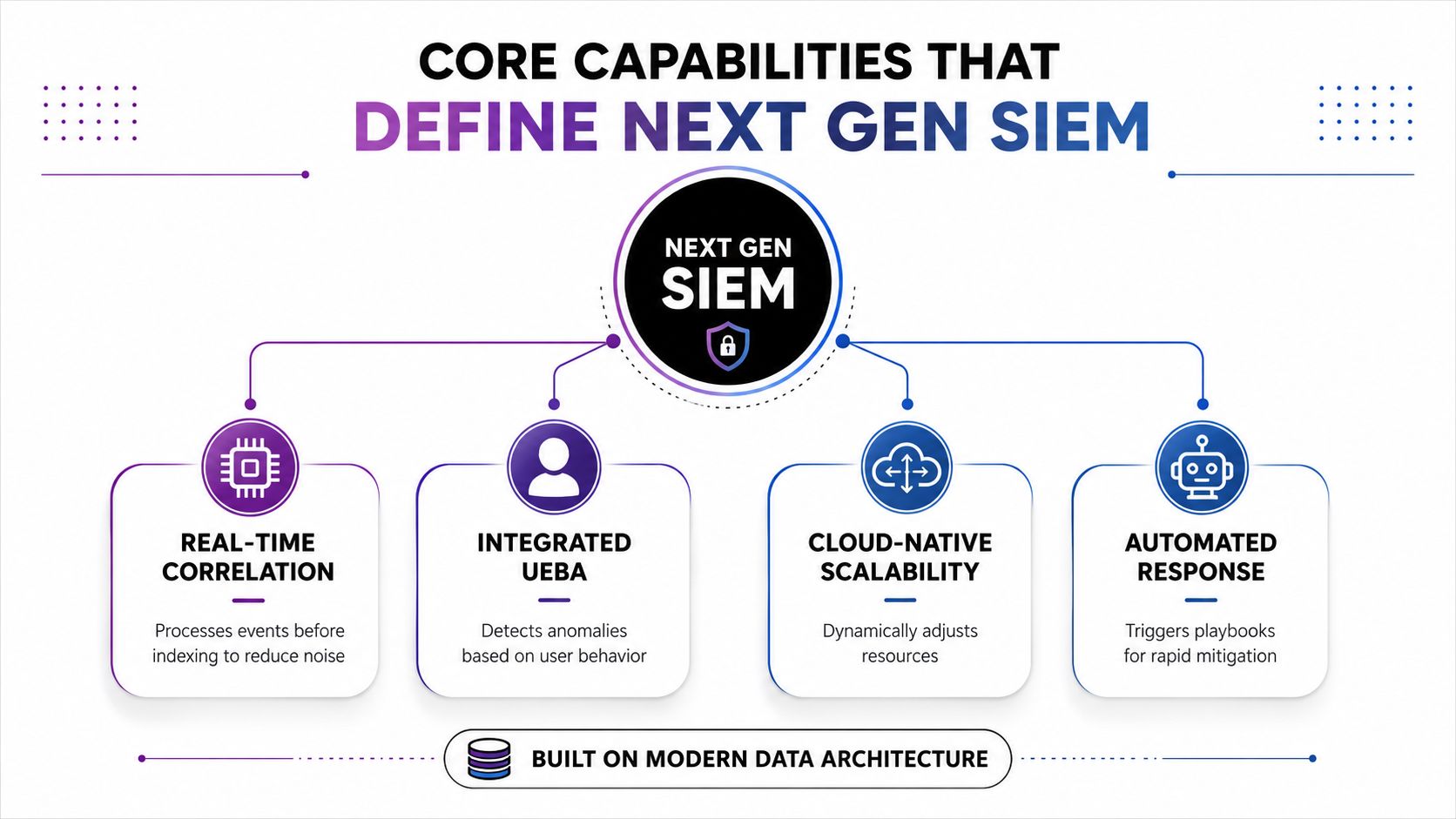
A useful next gen SIEM evaluation begins with what the platform does to data before a person sees it. In practice, the distinction appears in how rapidly the system correlates events, how much manual normalization it requires, how effectively it supports automation, and whether it can ingest the telemetry you already possess without turning your team into a permanent content factory. If any of those elements is absent, the vendor may still be useful, but the product is likely not mature enough to support a modern SOC by itself.
Detection and response should be one workflow
Next-gen SIEM systems are built to detect, investigate, prioritize, and respond to threats in real time (Seceon framing). That order is important because every handoff between detection and response adds time, and time is precisely what modern intrusions take advantage of. CrowdStrike's SIEM materials also highlight the scale of the problem by observing that 62% of alerts are ignored amid overwhelming noise, 82% of attacks are malware-free, and the average breakout time for modern intrusions is 29 minutes (CrowdStrike SIEM materialsThose numbers should remind us that a platform can no longer act as a passive archive.
A strong platform uses SOAR-style playbooks To keep containment consistent, it can isolate risky entities, direct cases to the proper queue, and record what happened for later review. This is not automation for its own sake; it is how teams stop response from depending on tribal knowledge.
Operational reality is important in this context. If automated response is overly aggressive, it can disrupt business processes, but if it is too cautious, analysts end up repeating the same steps daily. The correct balance is typically narrower than vendors suggest, and it hinges on your confidence in the detection logic, identity data, and downstream response actions.
Analyst context matters as much as raw detection
Behavioral analytics and UEBA They provide the most value when they give investigators a fast reason to trust or discard an alert. One guide states that next-gen SIEM combines SIEM, behavioral analytics, automation, and threat intelligence for real-time detection and response.Seceon overview), while implementation guidance also stresses connecting cloud, endpoint, identity, and business application data and pairing those sources with realistic playbooks (SGBox guidance).
That operational blend is where many purchasing choices fail. When telemetry arrives late, when the platform cannot keep enough context, or when detections require continual manual tuning to remain relevant, analyst productivity falls quickly. I care less about a demo that generates a clever alert than about whether the platform reduces triage time, lowers false positives, and prevents the queue from filling with cases no one trusts.
LLM-assisted triage belongs here when it speeds comprehension, not when it takes the place of judgment. Strong AI support condenses context, flags events that are probably related, and proposes next steps. Poor AI conceals its logic, demands more tuning, and makes every edge case one more review task.
Analysts do not require the platform to be clever behind the scenes. They require it to be explainable in the console.
For a closer look at detection workflow design, the internal guide on detection engineering deserves to be paired with your platform shortlist. The aim is not to purchase more detections; it is to create a detection workflow that withstands staffing gaps, environment changes, and the persistent tuning burden that every real deployment eventually encounters.
Evaluation Criteria for CISOs and Security Architects
The quickest way to make the wrong purchase is to assess the demo rather than the operating model. A polished console can mask poor ingestion economics, brittle tuning, or response features that function only when an engineer supervises them. A sound evaluation framework makes the vendor demonstrate that the platform suits your data, your team, and your compliance obligations.
Start with scale and retention
A credible next gen SIEM should answer three questions without vague assurances. How much telemetry can it ingest reliably, how does storage perform over time, and what occurs when you add new sources? The procurement specification referenced earlier is valuable because it treats scale as a strict engineering constraint, not a feature checklist. If a vendor cannot explain how it manages sustained throughput and retention without costly surprises, continue your search.
Ask about integration depth and tuning effort
The failure mode I encounter most often is shallow integration. In theory, a platform may support cloud sources, but in practice the implementation demands ongoing normalization work or fragile custom mappings. You need connectors that cut manual effort, along with sufficient control to tune detections without reworking the entire stack each quarter.
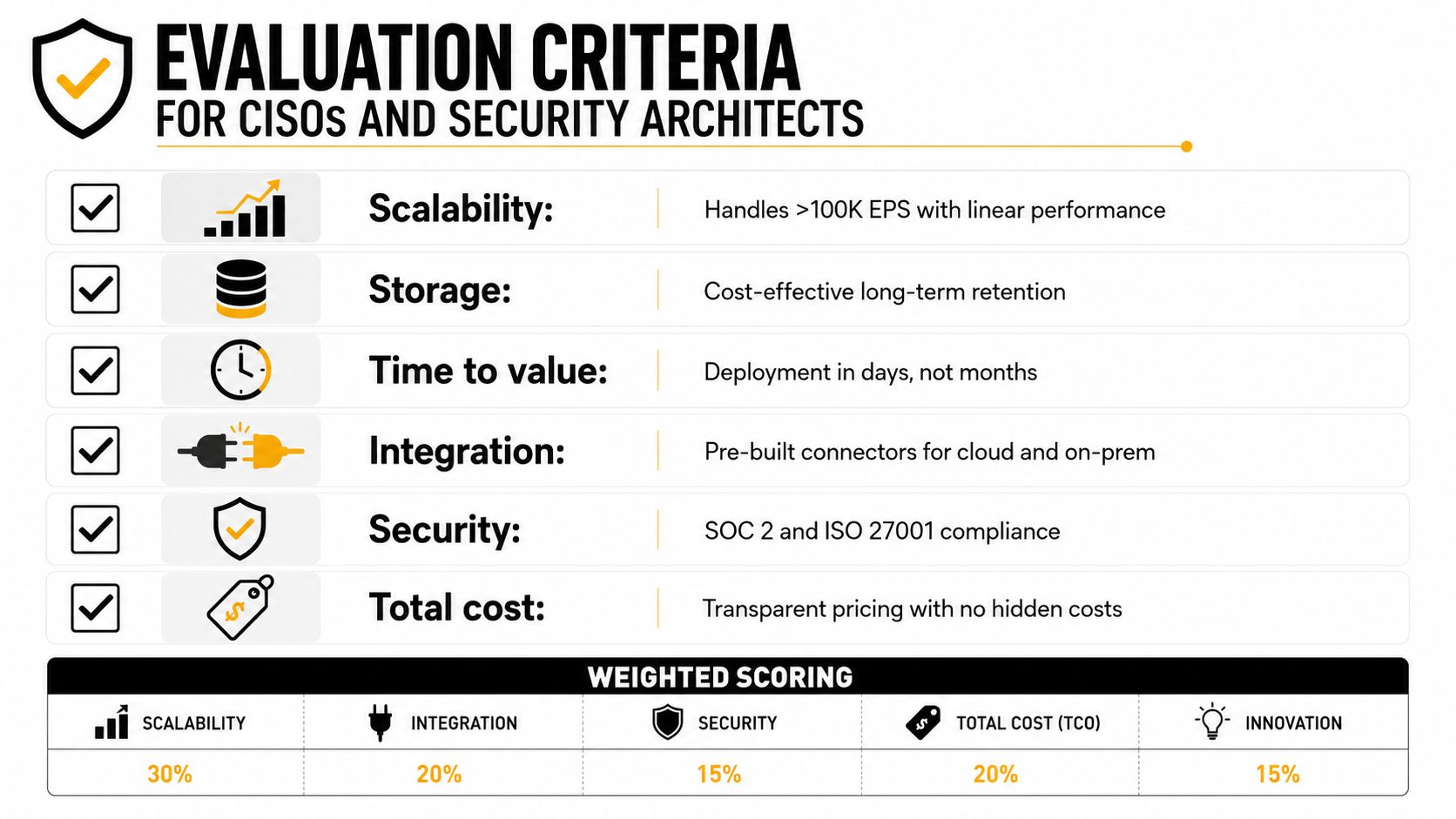
The evaluation chart below highlights the factors that usually count most in real deployments.
- Scalability: Confirm that the system can handle your anticipated telemetry mix without a costly redesign.
- Storage: Review how long-term retention is priced and whether cold storage stays searchable.
- Time to value: Expect deployment in days or weeks, not a project that drags on for a quarter.
- Integration: Verify built-in support for the cloud and on-prem sources you already operate.
- Security and compliance: Map outputs to HIPAA, PCI, CMMC, SOC 2, ISO 27001as well as the controls that fall within your audit scope.
- Total cost: Account for licensing, infrastructure, tuning labor, and analyst time, not only the invoice.
One additional factor matters more than marketing acknowledges. Guidance aimed at evaluators tells buyers to test transparency, explainability, customization, and the tuning effort needed to realize value.Kinney Group perspectiveIf the vendor cannot show how analysts will understand a decision, the AI becomes just another layer of opacity.
Deployment Architectures and Operational Models
Deployment decisions are where many teams make costly assumptions. A cloud-native platform may appear ideal on paper, yet a regulated environment with strict data sovereignty or retention requirements may still require on-premises control for certain logs. The proper architecture depends less on preference and more on the location of your compliance boundaries, staffing model, and data gravity.
Match the model to the operating reality
On-premises deployments remain a good fit for organizations that require strict control over where data is stored or rely on legacy integrations that are difficult to modernize. Cloud-native SaaS lowers infrastructure overhead and typically delivers value sooner, particularly when telemetry already spans multiple cloud services. Hybrid models make sense when you need a controlled core but cannot disregard remote endpoints, SaaS activity, and identity signals.
Managed SIEM is a separate decision. It can assist organizations without deep SOC expertise, but it also requires surrendering some operational autonomy. The trade-off is straightforward: you gain speed and coverage, yet you must accept less direct control over tuning and response design.
Remote work changed the baseline
The distributed environment is no longer the exception. It is the norm. That means cloud visibility is not an enhancement; it is part of the baseline architecture. The same applies to identity telemetry, since in a remote-heavy environment the attack path often travels through credentials, SaaS sessions, or endpoint compromise before it ever reaches a traditional data center.
A practical deployment model must also accommodate ongoing tuning of AI and ML logic. If the platform cannot improve detection quality over time without disrupting your workflow, it will become shelfware. The strongest deployments keep the architecture flexible enough to relocate sources, adjust retention policy, and add playbooks without replatforming annually.
Practical rule: Choose the deployment model that matches your compliance and staffing constraints first, then optimize for speed and automation within that boundary.
One sensible option in this category is Unified Security Stack, which brings SIEM, SOAR, XDR, and compliance workflows together in a single stack and supports log ingestion via APIs, Syslog, NetFlow, and agents. The architectural question still matters, but the model that wins is the one your team can operate after the first month.
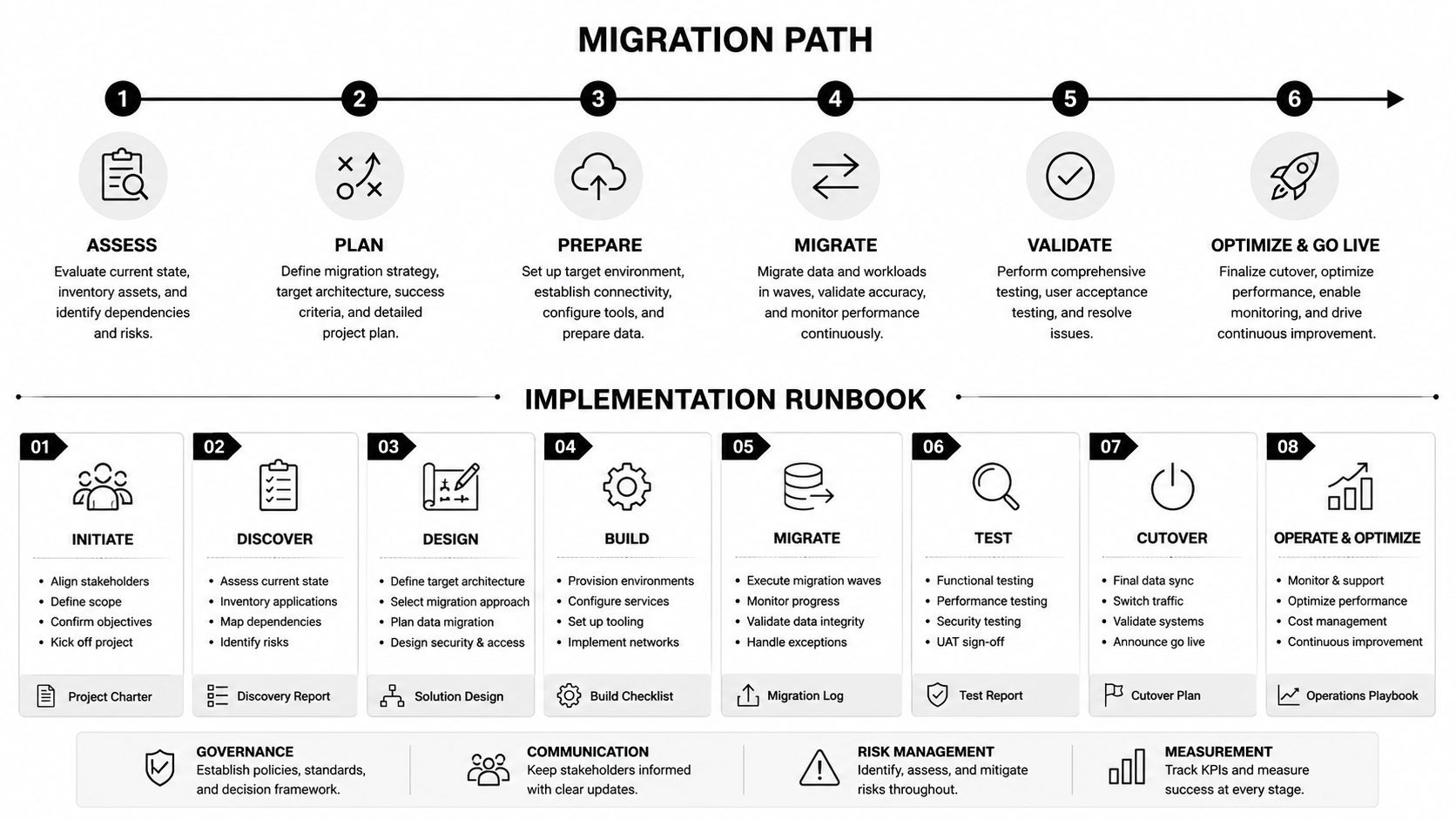
Migration Path and Implementation Runbook
A migration that safeguards production security operations begins with inventory, not tooling. Enumerate every log source, detection use case, compliance report, and integration the current SIEM supports, then identify which items are mission-critical and which can wait until phase two. If you skip that work, the cutover will reveal blind spots at the worst possible moment.
Run both systems before you retire anything
A parallel run offers the safest migration path. Maintain the legacy platform in service as the replacement consumes the same feeds, then compare correlation outcomes, alert reliability, and case management in both systems. This overlapping window is where you uncover parser issues, absent fields, and tuning shortfalls that surface only with live traffic.
A sensible milestone is reaching 95% log source migration before you even consider decommissioning the old stack. At that point, the remaining work typically involves edge sources, unusual compliance feeds, or one-off integrations that do not justify holding up the project. The cutover itself should be uneventful, because uneventful means you already addressed the risky parts.
Train the SOC where the work actually happens
Analyst training must center on the new workflow, not merely button clicks. Teach the team how alerts are prioritized, where context resides, how playbooks are triggered, and what requires manual approval. If the platform uses AI-assisted triage, the team also needs to understand when to trust it, when to override it, and how to feed corrections back into the tuning loop.
The largest implementation mistakes are predictable. Teams underestimate data volume, they go live before AI models are tuned, and they fail to update compliance reporting outputs. That combination produces a platform that appears functional in the demo environment and chaotic in production.
The migration timeline is most effective when handled as a control project.
- Catalog the sources along with their use cases. Capture every critical feed before building the first connector.
- Build the parallel path. Validate ingestion and normalization without disrupting existing operations.
- Tune detections early. Clear false positives before analysts take ownership of the new queue.
- Educate the team on workflows in live operation. Work from actual cases, not presentation slides.
- Cut over in stages. Retire legacy coverage only once the new system proves stable.
- Produce audit compliance outputs. Confirm that evidence and reporting still satisfy your control owners.
Measuring ROI and Operational Efficiency
The wrong way to measure next gen SIEM value comes from asking whether the interface looks modern. The useful approach is to compare detection quality, analyst workload, and operational cost before and after deployment. That requires tracking true-positive to false-positive ratio, MTTD, MTTR, and a productivity metric such as median clicks to action, since the platform either helps analysts move faster or it does not.
Telemetry cost control belongs in the same discussion. One industry guide recommends reducing data at the source or in the pipeline before the SIEM or lake, using APIs for on-demand enrichment rather than streaming every field, and measuring the operational outcome with KPIs that show whether the team is faster and more accurate (WWT guidance). That guidance matters because raw ingestion volume is easy to purchase and difficult to justify later.
ROI reaches its peak when the platform cuts incident response costs, shortens audit preparation, and reduces the odds that a missed event turns into a breach. It is weakest when the tool transfers effort from alert triage to data engineering. If your team spends more time trimming feeds than investigating threats, the cost savings you expected from modernization likely never appear.
A prudent buyer poses one final question: will this platform stay cost-effective as the environment expands? The response hinges less on the number of features and more on whether the architecture, tuning approach, and telemetry policy remain manageable under genuine SOC pressure.
If you're considering a move away from a legacy SIEM, Unified Security Stack is worth assessing because it unites real-time correlation, SOAR-style response, and compliance mapping in a single open-source platform. It is built for teams that need to control telemetry costs, reduce false positives, and keep analyst workflows practical in hybrid environments. Visit Unified Security Stack and weigh its approach against the operational needs of your own SOC.