Meeting HIPAA Log Retention Requirements in 2026
When the week begins, retention is seldom top of mind. You are focused on alert noise, a compliance audit request, and a storage bill that keeps rising as logs accumulate in your SIEM, EDR, or XDR stack.
Then a simple question comes up, yet the answer is anything but simple. Which logs need to be retained, for what period, and at what point should you stop relying on hot storage and begin preserving evidence for HIPAA?
Table of Contents
- Introduction to HIPAA Log Retention Requirements
- Understanding the Key Concepts
- Key HIPAA Documentation and Audit Control Requirements
- Log Types and Retention Timelines
- Legal Holds and Secure Storage Practices
- Implementing Retention Policies with Unified Security Stack
- Conclusion and Next Steps
Introduction to HIPAA Log Retention Requirements
A healthcare security team may run accurate detection rules throughout the year and still fail an audit when its evidence trail is weak. That is the trap with HIPAA log retention requirements, because the problem is not merely whether events were captured; it is whether the organization can still demonstrate what occurred once the investigation window has closed.
HIPAA's retention framework divides the issue into two parts. Compliance documentation follows the federal Security Rule baseline, while medical-record retention follows state law rather than HIPAA itself, and that gap confuses many teams that manage logs through SIEM and XDR platforms. When policy, audit evidence, and system activity are all kept in separate locations, retention must be built as an evidence system, not treated as a storage afterthought.
Practical rule: when a log supports your proof of access control, investigation history, or policy enforcement, treat it as compliance evidence, not simply telemetry.
The objective is straightforward. Anchor on the six-year floor in HIPAA, then design hot, warm, and cold log tiers around actual investigation needs, legal holds, and secure destruction. This produces a retention model that can be defended in audits and is practical for security operations.
Understanding the Key Concepts
Documentation and records are not the same thing
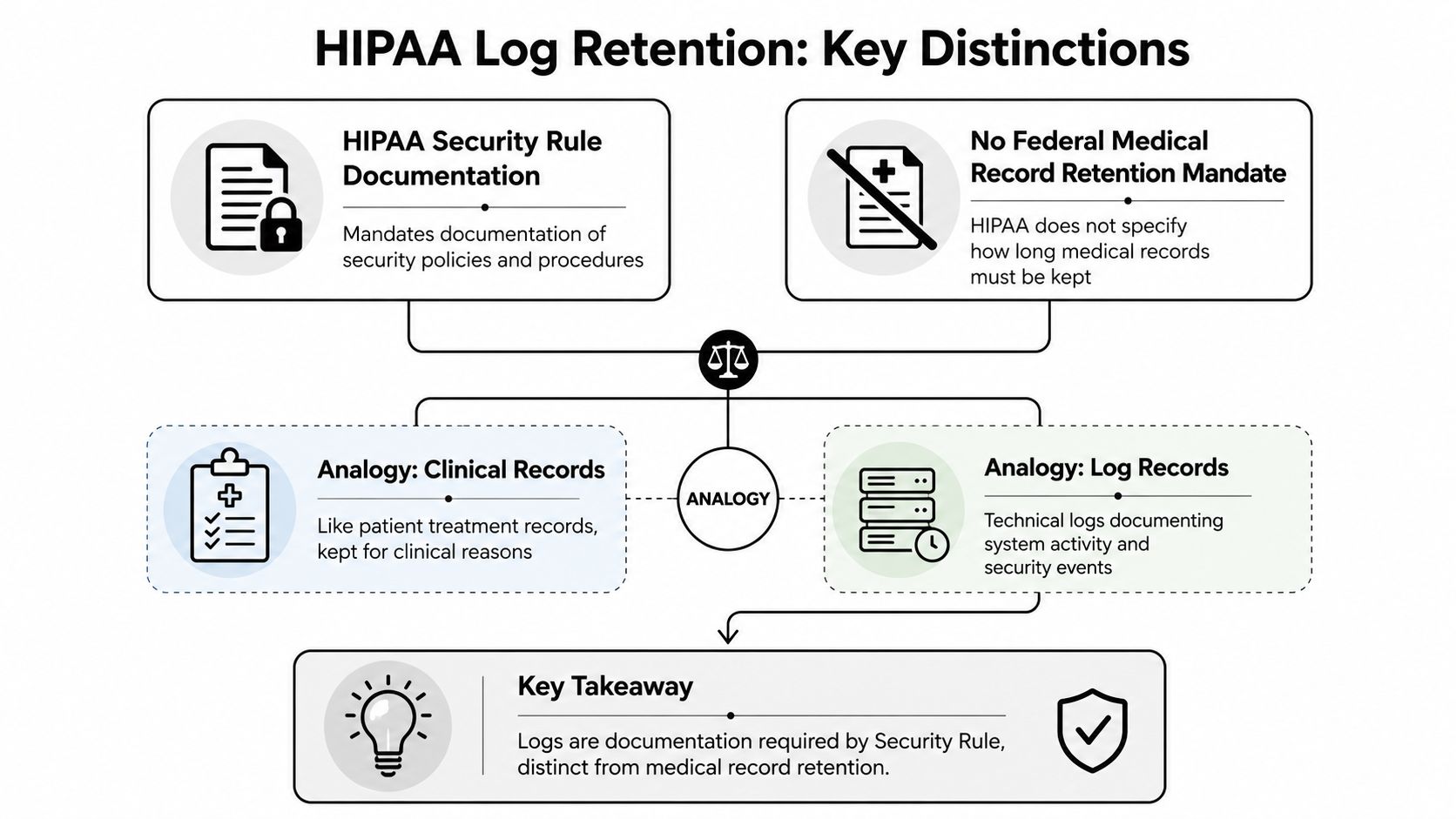
Documentation under the HIPAA Security Rule has a lifecycle of its own. Under the federal rule, covered entities and business associates retain required Security Rule documentation for six years from creation or from the date it was last in effect, whichever is later, but HIPAA does not establish a federal retention period for medical records. HHS states that state law controls how long patient records themselves must be retained, while HIPAA controls compliance documentation, so the two timelines may not align.
That separation has practical consequences. Consider patient records as the chart on a clinic floor, while audit logs are the camera footage and visitor log that show who entered, what they touched, and when. The chart is there for care, but the logs are there to prove control.
This difference explains why teams struggle when they attempt to apply a single retention policy to everything. A clinician may need a record for continuity of care, but a security architect needs the log archive to withstand a breach inquiry or an access review years later.
State law can push retention higher
When state law is more stringent, HIPAA does not supersede it. A compliance reference lists examples of logs that often require tracking, including user logins, database changes, new-user creation, access-level changes, file access, OS logins, firewall logs, and anti-malware logs, and states that the stricter standard prevails when state law demands longer retention. That means your policy requires a jurisdiction check before you finalize deletion timelines.
A risk-based retention model typically begins with three buckets. Hot storage supports rapid review, warm storage supports trend analysis and investigation, and cold storage protects the evidence archive. The precise windows depend on log value and volume, but the principle remains unchanged: keep the searchable window brief enough to manage cost, then retain the compliance archive long enough to meet the six-year floor and any stricter state requirement.
Viewed across the broader HIPAA program, your evidence chain must also align with your control mapping and policy inventory, not just your log platform. A helpful reference point is the internal HIPAA control baseline, which may be recorded with logging and access review procedures in the same compliance register. Consult the internal guide on HIPAA compliance requirements for a controls-focused perspective on the wider program.
Build around purpose, not just storage tiers
The simplest way to prevent confusion is to categorize logs by purpose. Some logs support incident response, some support auditability, and some support forensic reconstruction after the fact. Once those purposes are separated, the retention window becomes a policy decision rather than an estimate.
Not all logs age in the same manner. Evidence of high value requires long-term preservation, while high-volume telemetry can be moved to archive soon after it is no longer operationally useful.
Key HIPAA Documentation and Audit Control Requirements
HIPAA's core retention rule is a 6-year minimum. Under 45 CFR § 164.316(b)(2)(i), covered entities and business associates must retain required Security Rule documentation for six years from the date of creation or the date it was last in effect, whichever is later, and that later-effective-date detail matters when policies are revised midstream. A policy updated in year three can extend the retention clock beyond six years from the original draft, because the latest effective date controls.
That rule builds on the audit control requirement in the Security Rule. Put simply, your environment must record and examine activity in systems that contain or use ePHI, and your documentation must demonstrate that the control exists and was reviewed. The evidence set generally includes policies, procedures, risk assessments, audit logs, and system activity reports, because auditors use those artifacts to confirm that access controls are not merely theoretical.
Versioning changes the retention start date
Policy version control is a common area for error. Without the ability to demonstrate when a policy was initiated, updated, and authorized, you cannot definitively establish when the six-year retention period began. Consequently, precise timestamps, revision notes, and approval records are integral to retention strategy, extending beyond mere documentation practices.
This reasoning extends to proof of review. If your team audits access logs but fails to document the review results, you possess activity rather than evidence. A dated review annotation that cites the active policy version provides auditors with a clear link from control to evidence.
Audit controls need mapped evidence
The actionable step is to align each control with the logs that validate it. For instance, access logging verifies user accountability, system activity reports validate change reviews, and alert review notes confirm monitoring rigor. When these elements reside in disparate tools, the retention policy must still unify them into a single evidence trail.
Operational takeaway: If a log or report assists in demonstrating HIPAA control effectiveness, retain it under the same governance framework as the policy it supports.
The most robust programs integrate review findings into the retained records. This transforms a basic log repository into a documented control history, which is significantly easier to defend than an unorganized collection of files.
Log Types and Retention Timelines
Different logs have different jobs
HIPAA evidence does not come from only one log type. Access logs show who opened data, audit logs show what the system recorded, system logs reveal operating changes, application logs capture workflow activity, network flow records show movement across the environment, and security event logs Identify suspicious activity. Each type holds distinct investigative value, warranting a unique storage approach.
High-value authentication and access logs typically require the longest searchable duration, as investigators prioritize them during account abuse or disclosure inquiries. Network-flow and telemetry records are often noisier, making them more valuable in the short term and less useful once the incident window has passed.
Use a hot, warm, cold model
A technically sound architecture usually separates hot searchable retention from cold compliance retentionIndustry standards advise 60 to 90 days of indexed logs for rapid triage, 12 to 24 months of searchable logs for trend analysis, and then tamper-resistant archiving for up to the 6-year HIPAA documentation timeline. A separate technical compliance reference articulates this concept through a specific operational perspective, advising 90 to 180 days that summarized or indexed network-flow records remain online while full-fidelity archives are maintained for six years.
This division is effective because not every log requires permanent immediate searchability. Security teams require a brief online window for day-to-day operations, while compliance teams need a permanent archive for when OCR, legal counsel, or internal investigators request proof long after the event occurred.
Below is a practical matrix you can adjust for policy creation.
| Log Type | Hot Retention | Warm Retention | Cold Archive |
|---|---|---|---|
| Access logs | Searchable for rapid review | Searchable for trend analysis | Preserve to the HIPAA documentation window |
| Audit logs | Searchable for investigations | Searchable for control review | Preserve to the HIPAA documentation window |
| System logs | Short indexed window for triage | Retain if tied to changes or incidents | Preserve essential records in archive |
| Application logs | Keep recent events searchable | Retain for workflow tracing | Archive records tied to compliance evidence |
| Network flow records | Short indexed window for incident response | Keep summarized or searchable copies for analysis | Archive full-fidelity evidence as needed |
| Security event logs | Fast-access window for active response | Retain for anomaly analysis | Preserve tamper-resistant copies for audits |
Match retention to investigation value
Your retention decisions should reflect how frequently the log assists in answering questions. If analysts rely on it daily, maintain it in a searchable state for longer. If it is primarily relevant during audits or post-breach, transition it to archive sooner.
For teams that manage centralized logging in a SIEM, the storage infrastructure needs to support this tiering effectively. The log-management process in centralized log management serves as the appropriate design pattern to adopt here, as retention becomes a policy-based function rather than a manual cleanup chore.
Legal Holds and Secure Storage Practices
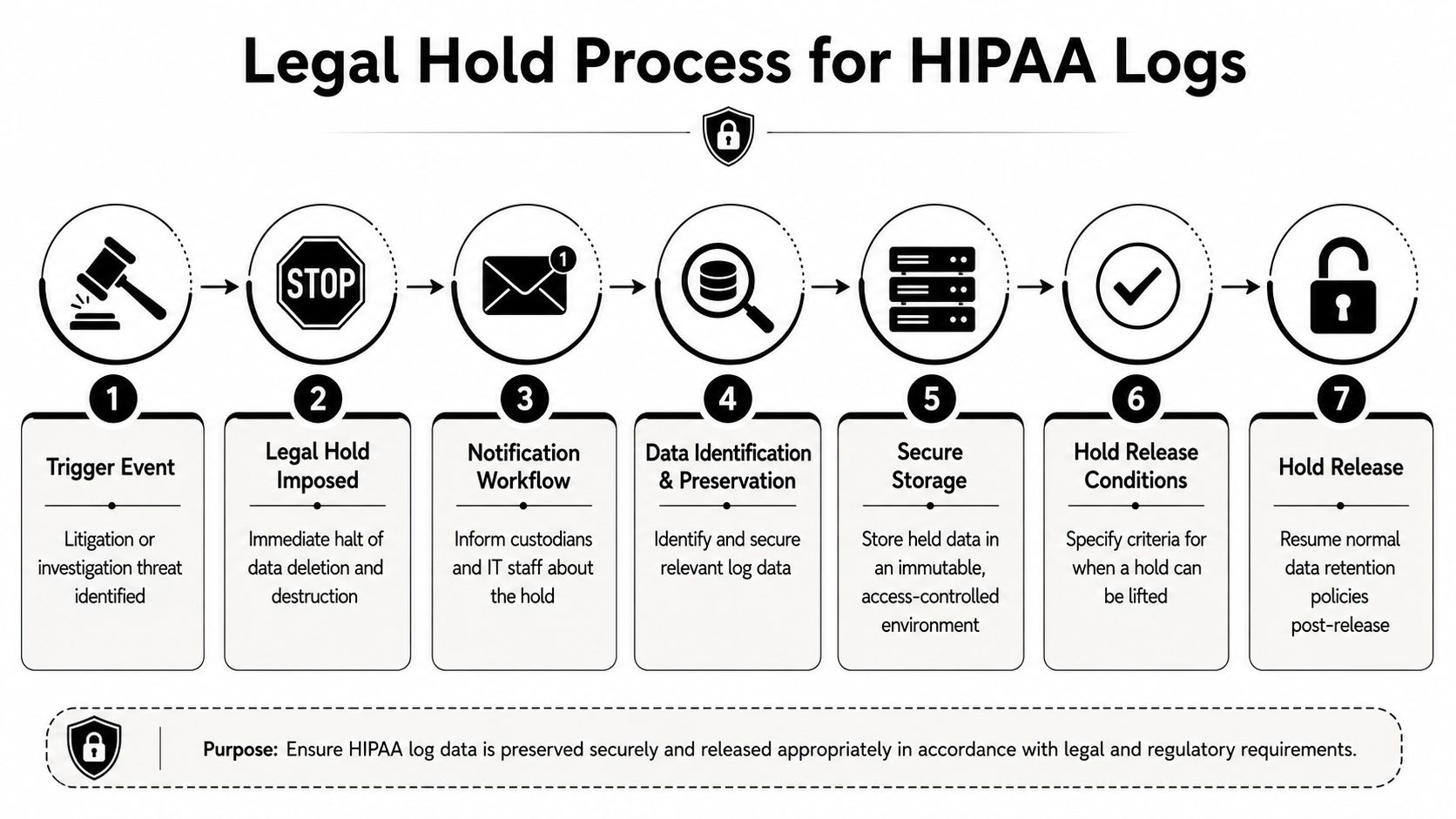
A legal hold instantly alters the retention landscape. If litigation, a regulatory inquiry, or an internal investigation commences, deletion ceases for the relevant records, even if standard retention rules would otherwise permit purging. This hold requires a trigger, an owner, a notification protocol, and a release condition; otherwise, it becomes an informal pause that no one can justify later.
Build the hold workflow before you need it
The trigger might be a notification from counsel, a breach investigation, or an escalation from the security team. Once triggered, custodians and IT personnel must identify the data in scope, its location, and who holds the authority to freeze deletion. When the matter concludes, the release must be documented as thoroughly as the hold itself.
Make archives tamper-evident
Secure storage must safeguard integrity, not merely availability. WORM storage helps because it prevents silent edits, and cryptographic hashing provides a method to detect tampering if someone attempts to modify a retained file. Immutable cloud storage or an on-premises archive can both be effective if access controls are strict and deletion is governed.
Chain-of-custody documentation is as critical as the storage medium. If a held log is exported, copied, or restored, document who handled it, when it moved, and where it was stored. This record constitutes part of the evidence.
A valuable addition is a plain-language standard for destruction after retention expires. The requirements for data destruction guidance serves as a useful reference for defining that final step, as compliance is not fully achieved until obsolete copies are eliminated.
Preserve what you are obligated to keep, destroy what you no longer require, and maintain a record of both actions.
This hybrid model aligns with HHS’s position that organizations may need searchable recent logs, immutable archives, and secure destruction post-retention when state law, incident response, or modern storage practices necessitate it. The operational challenge is keeping these three stages distinct in both policy and tooling.
Implementing Retention Policies with Unified Security Stack
Begin with ingestion. HIPAA evidence is only effective if the platform gathers essential data from endpoints, network devices, and cloud services via agents, APIs, and Syslog feeds. In a SIEM or XDR configuration, the primary objective is to ensure sources are normalized sufficiently so that access, audit, and system events can be searched consistently.
Configure tiers and controls in the platform
Once ingestion is stable, establish retention tiers within the log-management module. Recent logs belong in the searchable tier for triage and investigations, older logs migrate to archive, and deletion should occur automatically once the policy window closes and no hold applies. If the platform offers immutable storage controls, enable them for the compliance archive.
Unified Security Stack serves as a viable solution by integrating log management, SIEM-like correlation, and compliance workflows into a unified platform. This is critical in healthcare settings where identical evidence must support detection, analysis, and audit reporting without requiring analysts to switch between disconnected tools.
Tie policy to correlation and reporting
Retention policy enforcement should not operate separately from detection logic. Correlation rules must identify suspicious access patterns while also highlighting log-policy violations, absent sources, or compromised retention tags. When the platform links specific evidence to corresponding HIPAA controls, compliance reviews accelerate significantly.
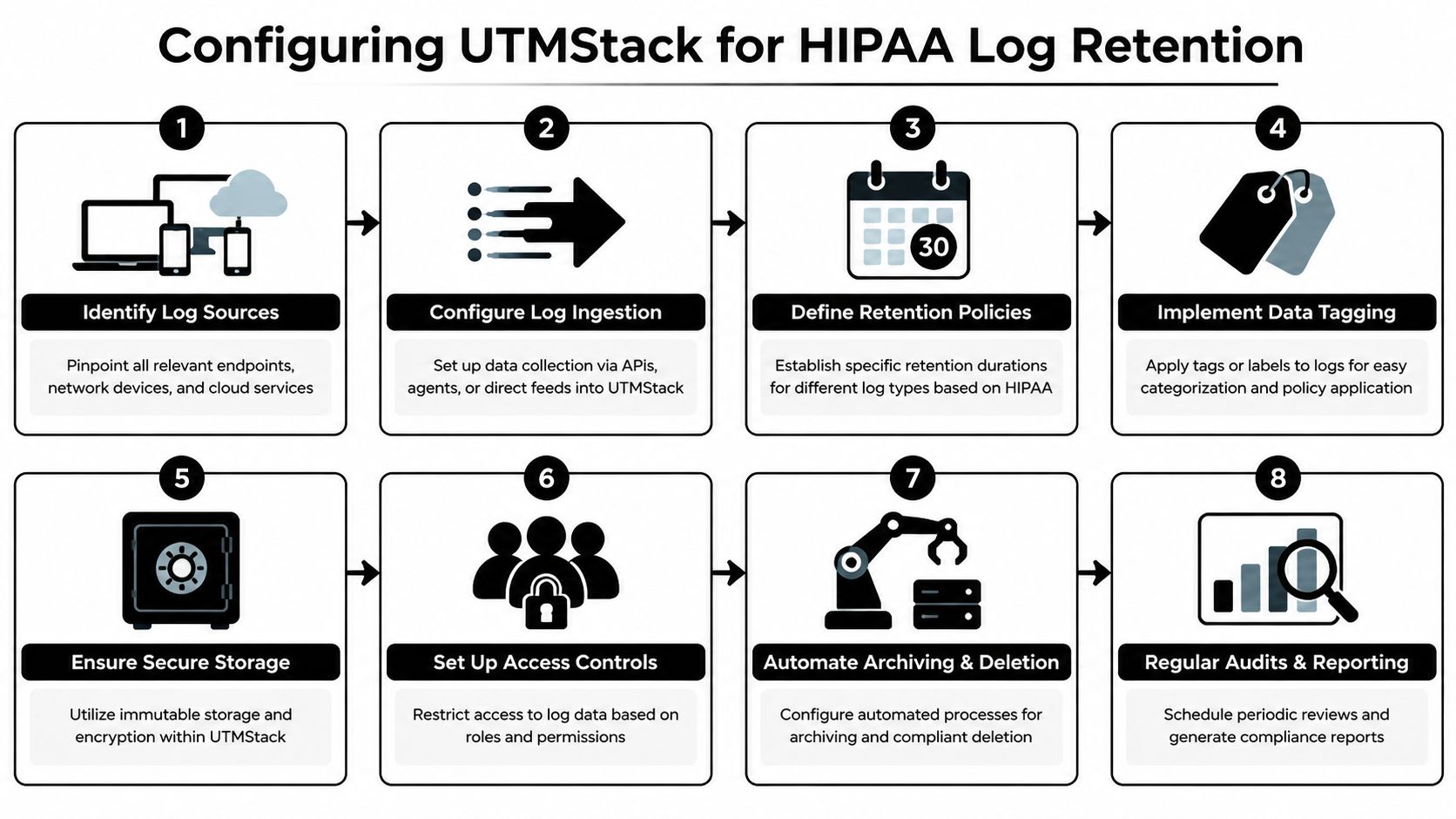
A well-developed workflow also automates policy reviews and produces compliance reports on a regular schedule. The key element is not merely the report itself, but the capability to demonstrate that retention rules, archive status, and access reviews were validated against the active policy.
Leading healthcare compliance standards view audit and access logs as essential evidence for proving HIPAA compliance, with many organizations retaining them for at least six years even if operational SIEM copies are kept for shorter durations, necessitating a deliberate archive tier. The internal perspective on log management and correlation in SIEM is beneficial when aligning retention strategies with detection engineering.
Effective retention policy design does not conflict with the SOC. It provides the SOC with a brief searchable window while offering compliance teams a persistent archive.
Conclusion and Next Steps
HIPAA log retention starts with one hard number, the six-year the federal baseline for Security Rule documentation, yet the broader program extends beyond that scope. Optimal designs segregate logs into hot, warm, and cold tiers, maintain evidence in tamper-proof archives, and halt deletion upon legal hold activation.
If you own the policy, prioritize verifying three aspects. Identify which logs support HIPAA evidence, determine if state regulations impose stricter requirements, and ensure your archive can demonstrate integrity over time. Subsequently, test if your existing SIEM, XDR, or log platform can enforce these rules rather than simply storing data.
A strategic next step involves drafting or updating your retention matrix, assigning ownership for holds, and conducting a simulated audit of the evidence trail. If your current process cannot identify who accessed what, when policy changes occurred, or when archive deletion is permitted, the deficiency is already apparent.
Unified Security Stack enables security teams to collect logs, correlate events, and manage retention centrally, simplifying the preservation and review of HIPAA evidence. When constructing a defensible log-retention program, visit Unified Security Stack to assess how its open-source SIEM, SOAR, and XDR modules align with your compliance workflow.