What Is Noise Reduction in SIEM and Security Monitoring
At the start of a shift, a SOC analyst faces a queue filled with alerts. The first investigations show repeated authentication failures tied to one service account, blocked network scans originating from a known internal scanner, and endpoint events that three separate sensors logged independently. A genuine compromise might be hidden in that queue, but the analyst must sift through the noise first.
That's the operational meaning of noise reduction in SIEM and security monitoringIt is the methodical practice of cutting irrelevant, duplicate, and low-value alerts while keeping the evidence and visibility required to spot real threats. This work covers ingestion, correlation, suppression, thresholding, investigation, and response. It is not a one-time setting to enable and forget, since environments evolve, fresh telemetry arrives, and what was benign yesterday can turn into tomorrow's blind spot.
Table of Contents
- The Alert Overload Problem in Modern SOCs
- Root Causes of Alert Noise in Security Monitoring
- Core Noise Reduction Techniques for SIEM Environments
- How AI and Machine Learning Transform Noise Reduction
- Measuring Noise Reduction Effectiveness in Your SOC
- Benefits of Systematic Noise Reduction for Security Operations
- Implementing a Noise Reduction Strategy with Unified Security Stack
The Alert Overload Problem in Modern SOCs
Alert fatigue is a security risk, not just a productivity issue. When analysts keep examining events that prove harmless, they have less attention left for alerts that demand judgment. A large queue can also skew prioritization. Teams start with the easiest alerts instead of the most important ones, because reducing volume feels easier than evaluating ambiguity.
That distinction matters within a SIEM or XDR pipeline. Raw logs are records. Alerts are interpretations of those records, generally generated when rules, thresholds, analytics, or detections find a condition that merits review. Noise emerges when the interpretation produces too many repetitive, irrelevant, or poorly contextualized tasks for the analysts available.
One security vendor reports that over 50% of SIEM alerts are false positives, while some organizations report rates as high as 80%The same source states that routine SIEM tuning frequently lowers noise by only 10–20% temporarilybecause additional sources create unwanted activity again and aggressive tuning can hide genuine threats. Such figures explain why alert fatigue endures even after a team has reviewed its rules. The SIEM alert-fatigue analysis describes the issue as a persistent balance between cutting volume and retaining detection coverage.
Operational reality: A smaller queue does not necessarily mean a safer one. The real question is whether analysts can recognize and respond to significant events with more confidence.
A workable definition of noise reduction thus has two results. The system should take unnecessary work out of the analyst queue, and it should preserve the underlying telemetry, context, and audit trail required for investigation. Suppressing a known benign event from notifications can make sense. Removing its source log can leave a compliance or forensic gap.
Teams should approach noise reduction as an operational discipline. They need rule owners, review triggers for environment changes, and metrics that reveal when alert quality is declining. A rule tuned in a stable deployment may behave quite differently once a new identity provider, endpoint fleet, cloud workload, or vulnerability scanner appears. For a practical discussion of this operational problem, see this guide to reducing false positives in SIEM systems.
Root Causes of Alert Noise in Security Monitoring
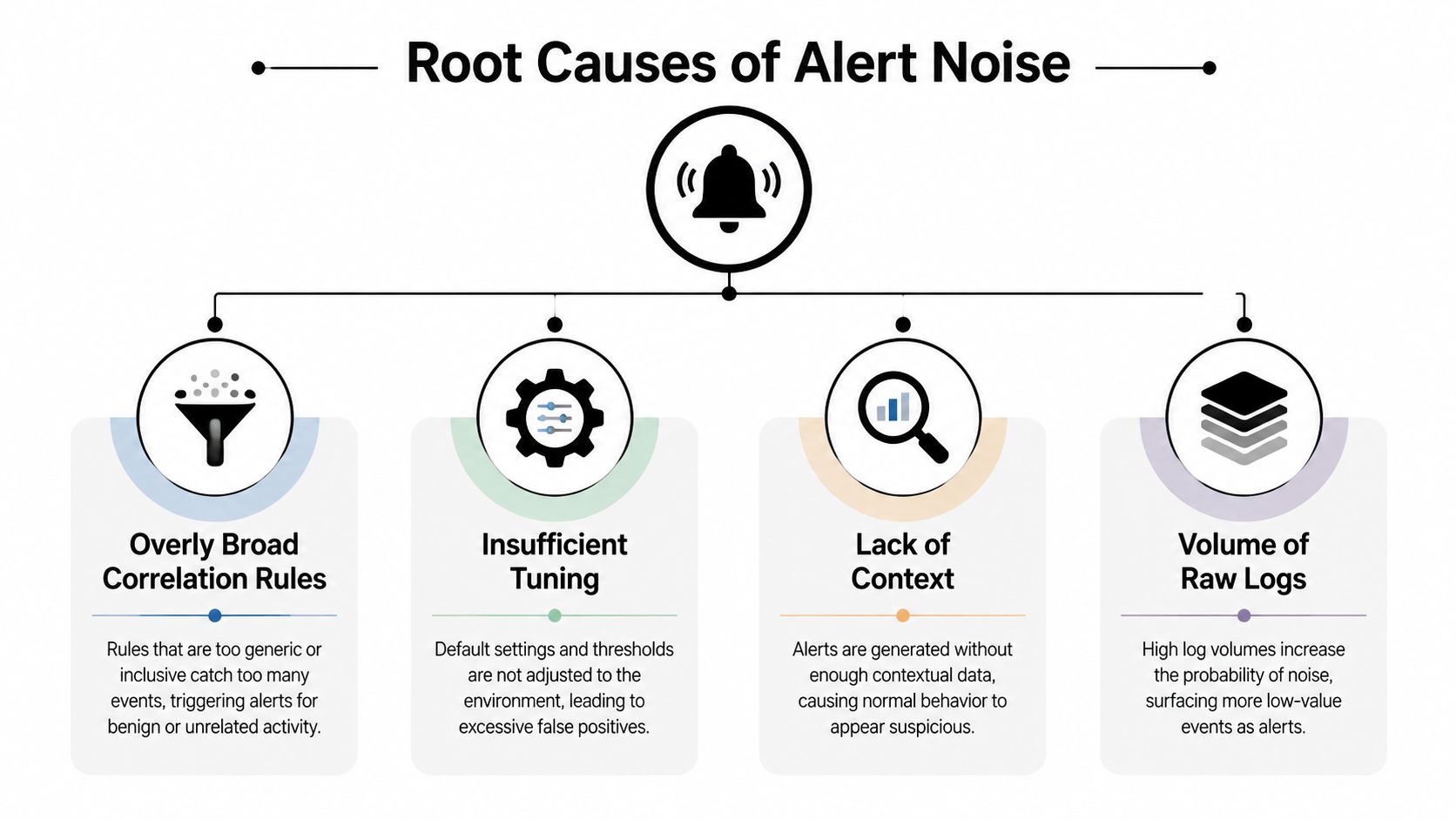
Noise typically has a particular cause, and that cause points to the correct remedy. Blanket suppression across every noisy alert can conceal a genuine attack, while adjusting a threshold will not fix duplicate telemetry from overlapping collectors.
Broad rules create predictable false positives
A correlation rule that triggers on every failed login can surface suspicious behavior, but it may also fire when a service account retries an expired credential. The rule is not necessarily faulty. Its condition is simply too broad for the environment. Analysts need identity type, source, destination, time pattern, and recent administrative activity before they can tell routine failure apart from password spraying.
Firewall detections pose a comparable issue. A rule can alert on every blocked scan, even if the source is an approved vulnerability scanner or a recognized security-testing system. The right response is typically a scoped exception, an asset-aware condition, or a scheduled suppression window, rather than deleting all blocked-scan telemetry.
Duplicate collection multiplies the same event
One activity can reach a SIEM through an endpoint agent, a cloud API, a network sensor, and a forwarding relay. If the platform does not recognize that these records describe the same underlying action, analysts may get multiple alerts for a single event. Deduplication and normalized event identifiers tackle this type of noise more directly than rule suppression.
Missing context prevents useful decisions
When a detection omits asset criticality, user role, ownership, threat intelligence, or historical behavior, its alerts are often weak. A new administrative login could be routine for a privileged operations account, or it could point to credential abuse. The event by itself cannot resolve that question. Context establishes whether the analyst should investigate, escalate, or document the activity.
Environmental change invalidates old tuning
Rules deteriorate over time. A business introduces a SaaS platform, alters remote access, adopts a new endpoint control, or reorganizes service accounts. Patterns once considered unusual become routine, while new legitimate workflows create alerts. Ongoing review is required because tuning is only temporary unless someone sustains it. Guidance on SIEM tuning and alert suppression advises treating thresholding and suppression as formal, continuing controls rather than one-time fixes.
The diagnostic process should stay simple: determine whether the alert is duplicated, overly broad, lacking context, or stale. Then apply the most narrowly scoped remediation that fits that cause. This approach retains more detection value than treating each noisy rule as a candidate for blanket exclusion.
Core Noise Reduction Techniques for SIEM Environments
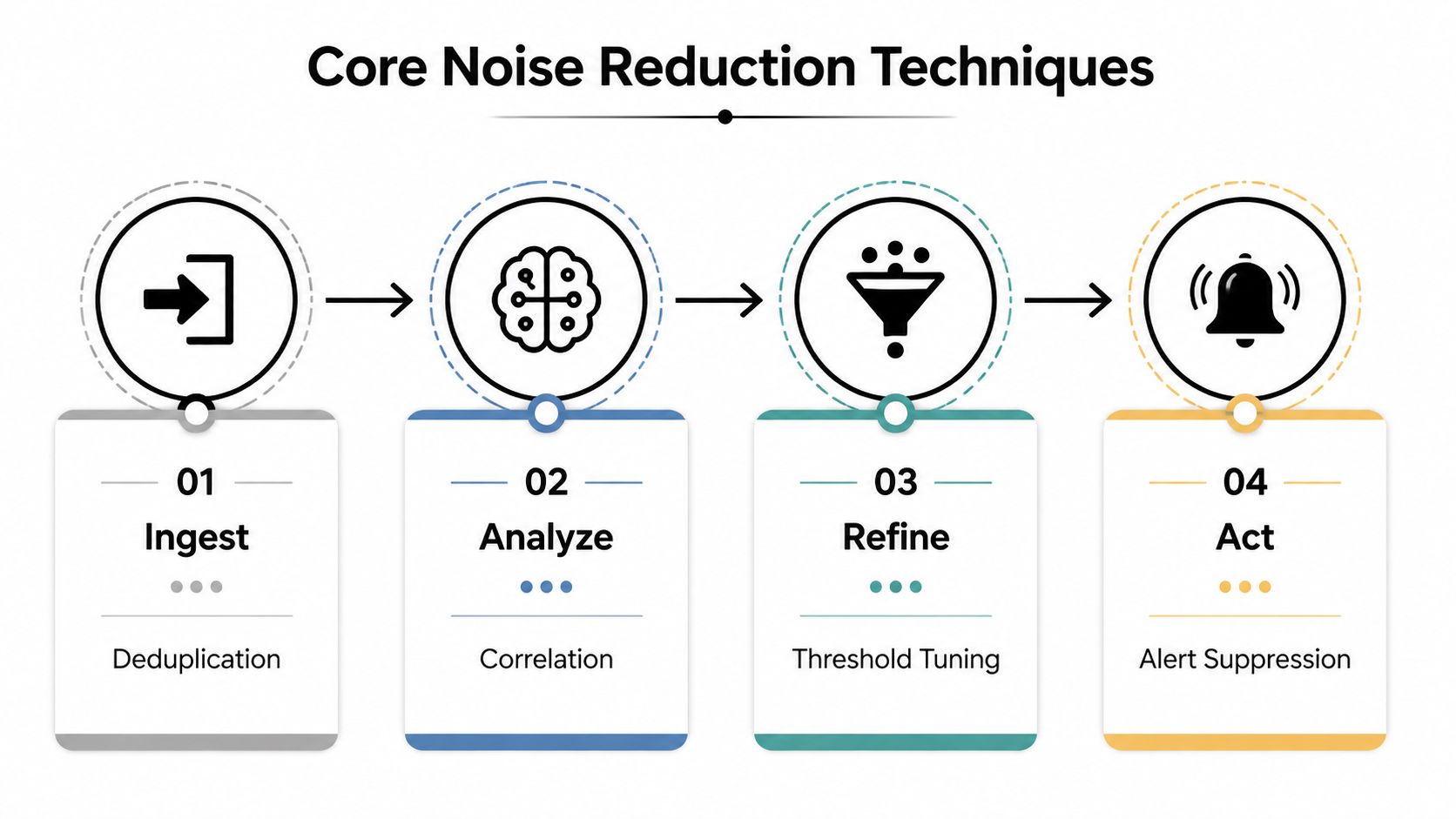
Effective pipelines apply multiple mechanisms in sequence. Each reduces a distinct form of waste, and each comes with a trade-off.
Deduplication at ingestion
Deduplication finds repeated representations of the same event and merges them into a single investigative object. Matching may rely on fields such as event type, account, host, process, source, destination, and time proximity. The result is fewer duplicate alerts, while the system can keep occurrence counts and supporting records for analysis.
This proves helpful when multiple collectors surface the same endpoint or authentication activity. It does not replace correlation. Two alike events might be a single action repeated, or they could signal a campaign shifting between systems. Since weak matching can combine separate incidents, deduplication keys must be validated with actual telemetry.
Correlation across time and sources
Correlation rules link related events into a pattern. One failed login might not matter. A series with repeated failures, a successful login, privilege use, and access to a sensitive system carries more weight. Time windows allow the rule to assess relationships instead of isolated records.
Stateful logic enhances this by retaining earlier conditions and assembling events across multiple stages. SIEM correlation rule guidance is helpful when creating rules that link identity, endpoint, network, and cloud signals.
Suppression without destroying evidence
Suppression stops a known benign pattern from producing repeated alerts. Effective suppression is narrow, documented, time-bound when needed, and assigned to an owner. It may apply to an approved scanner during a maintenance window or a service account with expected retry behavior.
The risk is clear. A suppression rule can stay active after the business process changes. Retain the original logs, document why the exception exists, and review whether the condition still matches approved behavior.
Thresholding and event grouping
Thresholding increases the level of activity needed for a detection to trigger. A rule can combine repeated events within a time window and alert only after activity surpasses a meaningful threshold. This is useful for brute-force patterns, repeated process launches, or recurring network connections.
Thresholds should not be selected merely to shrink the queue. A low threshold boosts sensitivity but generates noise. A high threshold lowers workload but can delay detection or overlook low-and-slow behavior. Stateful rules, asset criticality, and escalation paths should shape the decision.
Practical rule: Adjust the notification layer before deleting telemetry. Analysts need fewer interruptions, but investigators and auditors still require the evidence.
The most robust design blends these controls. Deduplication cuts repetition, correlation adds meaning, thresholding filters weak patterns, and suppression manages approved exceptions. No single technique can safely address every source of alert noise.
How AI and Machine Learning Transform Noise Reduction
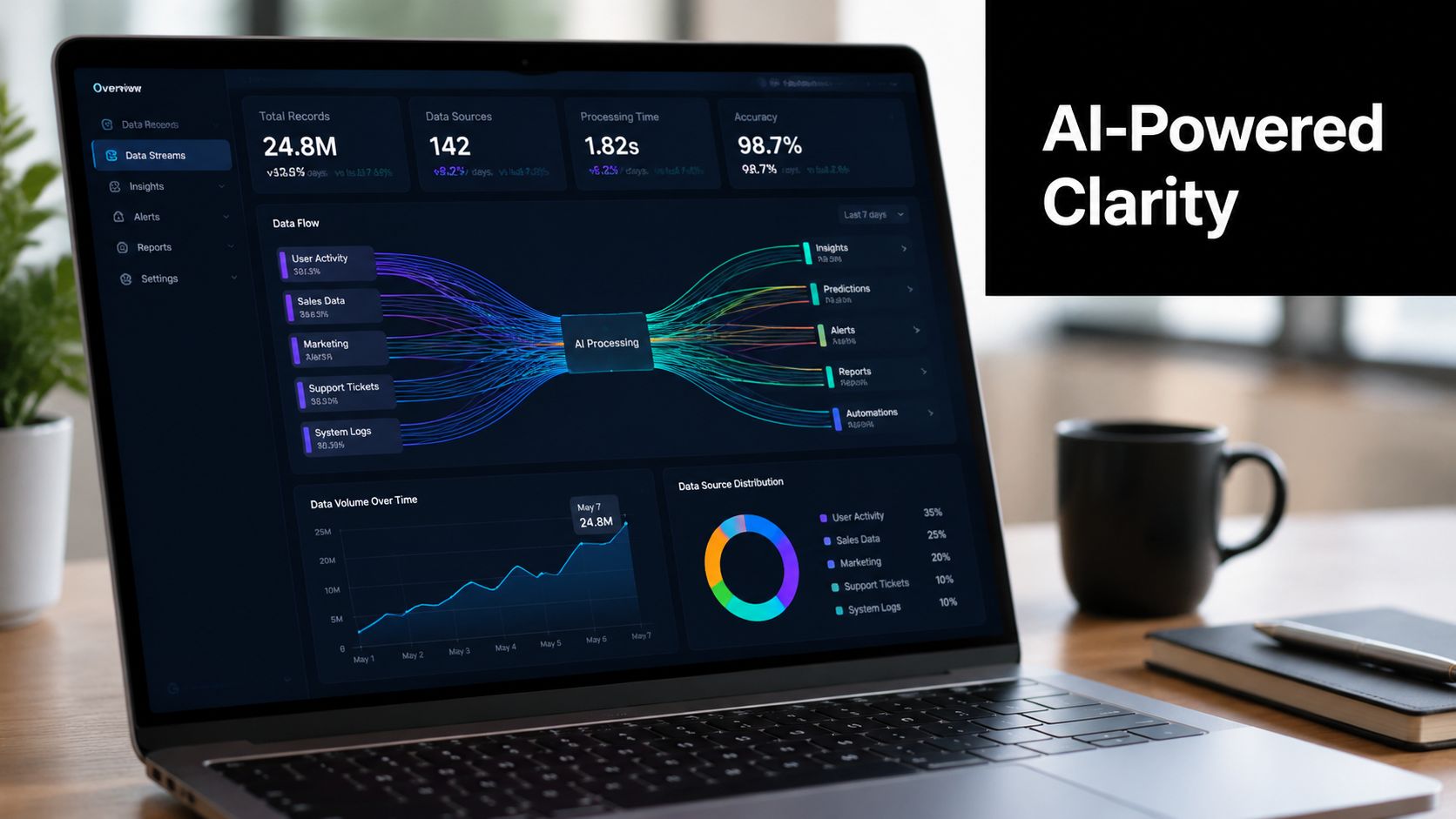
Static rules remain necessary, yet they struggle with shifting behavior and high-volume context. Machine learning can model normal activity and reveal deviations, while large language models can help analysts grasp what an alert means and which evidence warrants attention. Neither should be given unchecked power to dismiss security events.
Baselines add behavioral context
An effective model separates expected variance from suspicious deviation. A privileged account logging in from its usual administrative host during normal operating hours may be less urgent than the same account authenticating from an unfamiliar location and immediately accessing sensitive resources. The model does not prove intent. It helps prioritize the investigation and provides context to the rule engine.
Governance is also necessary for baseline systems. Normal behavior may encompass an attacker who has established persistence. Analysts need the ability to review the features underlying a recommendation, dispute an inaccurate baseline, and keep sensitive exceptions from disappearing from view.
LLMs reduce explanation effort
A triage layer assisted by an LLM can describe related events in natural language, name the entities involved, clarify why a rule fired, and propose investigative questions. This reduces the time analysts need to turn raw records into a working hypothesis. It can also help recommend rule changes derived from recurring false-positive patterns.
The model should assist rather than decide on its own. Human reviewers still need to validate severity, examine original evidence, and approve suppression or containment actions. Handling sensitive data, prompt controls, logging, and access permissions matter just as much as the quality of the model.
Layering is more reliable than replacement
A practical pipeline can use deterministic controls first, analytics next, and human review at the decision boundary:
- Normalize and deduplicate incoming records.
- Correlate activity that is connected across sources and time.
- Apply thresholds and scoped suppression to known patterns.
- Use behavioral analytics and LLM triage for adding context and ranking work.
- Require analyst approval for rule changes with major impact and automated response.
Unified Security Stack can serve as a single concrete implementation reference. Its platform correlates events in real time prior to indexing, and its built-in large language models help with alert triage, rule tuning, and false-positive reduction. The important design principle is not that AI takes the place of detection engineering. It is that automation manages repetitive interpretation while analysts keep responsibility for consequential decisions. Unified Security Stack's AI-powered threat detection overview outlines this type of unified workflow.
Measuring Noise Reduction Effectiveness in Your SOC
A team cannot manage alert quality through queue size alone. A smaller queue may show better detection engineering, or it may mean analysts no longer see important events. Measurement should tie volume, quality, speed, and coverage together.
Start by documenting a baseline for every major alert category before you modify rules. Record total alerts, duplicates, confirmed false positives, escalations, triage time, and analyst effort. After the change, compare the same categories under consistent definitions. Without such a baseline, assertions of improvement stay subjective.
| Metric | Definition | Target Indicator |
|---|---|---|
| False-positive rate | The share of reviewed alerts that analysts classify as non-actionable | A sustained downward direction without a corresponding decline in validated detections |
| Actionable-alert ratio | Actionable alerts compared with total generated alerts | A rising proportion of alerts that lead to investigation, escalation, or documented response |
| Mean time to triage | Time from alert creation to an initial analyst decision | Shorter triage time for comparable alert categories |
| Analyst time spent on noise | Time used on duplicate, benign, or non-actionable events | A declining share of investigative capacity devoted to low-value work |
| Suppression review status | Whether exceptions have owners, reasons, scope, and review dates | No unexplained or indefinitely unreviewed suppression |
The false-positive problem matters greatly because existing guidance cautions that tuning may provide only temporary relief once new data sources change the alert stream. Monitor metrics over time and note on dashboards when teams add collectors, alter identity workflows, deploy new controls, or change network architecture. Those events account for why a rule that was previously stable can start generating noise again.
Measurement discipline: Document detection quality and noise reduction side by side. Cutting volume without validating coverage does not amount to operational success.
Examine samples from activity that was suppressed or given low priority. Check for escalations that were overlooked, anomalous entities, and shifts in adversary behavior. Combine quantitative dashboards with regular analyst input, since a rule can hit a volume target yet still generate alerts that are hard to investigate.
Benefits of Systematic Noise Reduction for Security Operations
An orderly alert pipeline strengthens response by letting analysts devote more time to valuable investigations. The value is not a reduction in notifications. It is improved distribution of attention across identity, endpoint, network, cloud, and application activity.
Lower noise also safeguards the personnel who run the SOC. Closing the same harmless alert again and again is dispiriting, and analysts whose shifts are consumed by low-value tasks have fewer chances to build detection, hunting, and incident-response skills. Improved prioritization makes the queue easier to justify and provides managers with a stronger foundation for staffing and escalation choices.
Compliance teams obtain a more robust evidence trail when the platform keeps raw telemetry, detection logic, exceptions, analyst decisions, and response actions distinct. Frameworks including HIPAA, PCI, CMMC, and SOC 2 require organizations to show suitable monitoring and control practices. Noise reduction alone does not meet those frameworks, but it can make activity relevant to audits easier to locate, examine, and explain.
The same logic applies to ISO 27001, GLBA, as well as other governance programs. A pipeline that preserves logs while reducing unnecessary alerts supports both operational investigation and evidence gathering. Analysts can show why a detection triggered, what context was considered, whether an exception applied, and how the organization responded.
Reducing noise also raises the return on existing SIEM and XDR investments. A platform that generates many weak alerts can be technically capable yet underused in practice. Improved correlation and triage help teams leverage the telemetry they already gather without immediately addressing every workload issue by adding headcount or expanding licensing.
For CISOs, the business case should center on risk and control quality. The aim is not a dashboard that looks smaller. It is a monitoring process that channels limited expertise toward credible threats while retaining the records needed for investigation, reporting, and assurance.
Implementing a Noise Reduction Strategy with Unified Security Stack
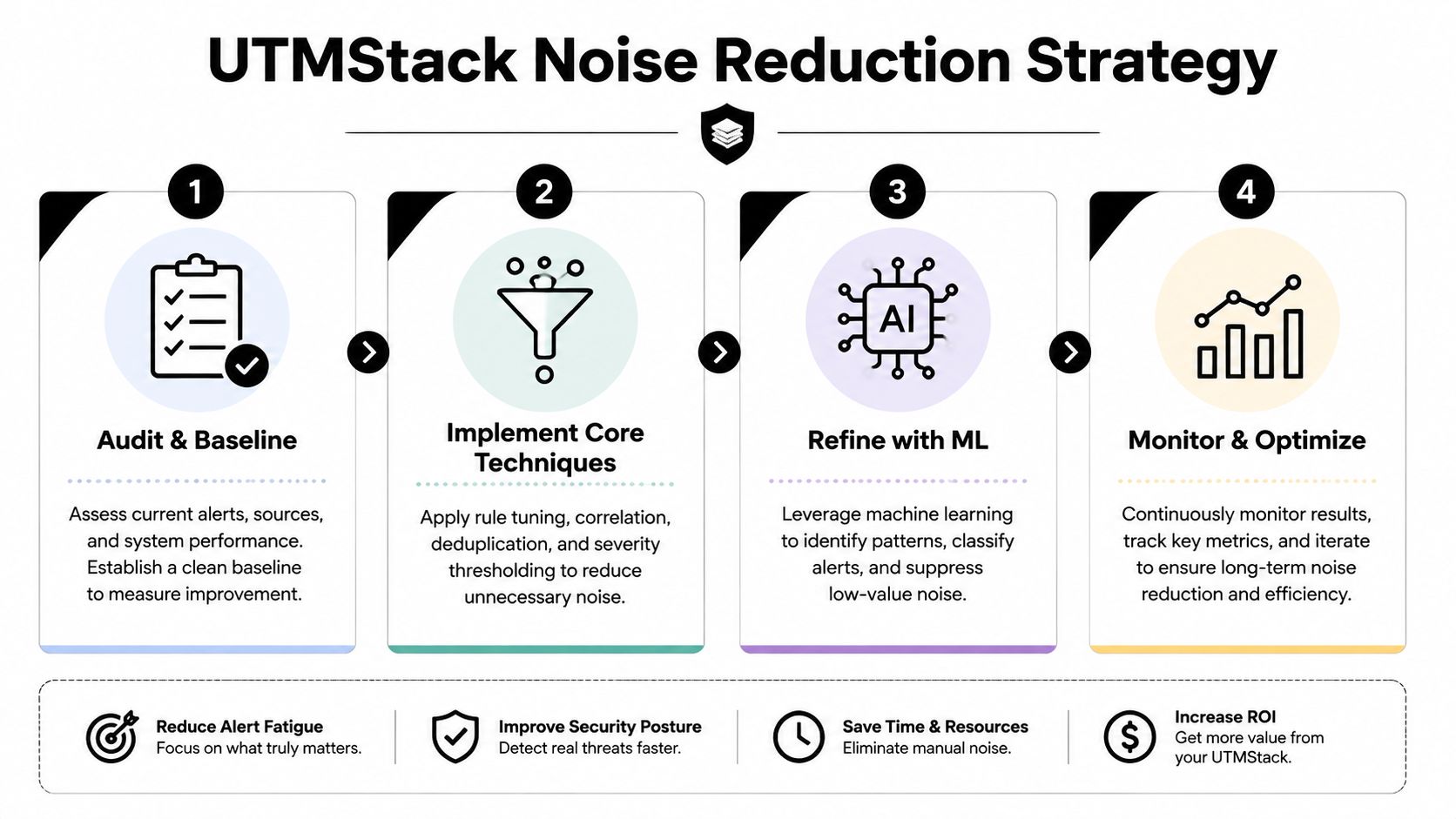
Implementation should start with evidence, not with removing rules. Create an inventory of log sources, collectors, parsers, alert rules, suppression conditions, and ownership. Determine which alerts are duplicates, which are always benign, which lack context, and which provide useful detections.
Start with an auditable baseline
Track alert categories, false-positive determinations, triage duration, and current exceptions. Verify whether important sources arrive more than once via agents, APIs, Syslog, or network telemetry. Normalize fields before altering detection logic, since inconsistent usernames, hostnames, timestamps, and event types can cause a valid rule to seem unreliable.
Then examine the rules that generate the most volume. Review sample events, not only rule names. Incorporate identity, asset, process, vulnerability, and change-management context where it increases confidence. A failed login rule may require service-account treatment, while a blocked connection rule may require awareness of approved scanners.
Apply the narrowest control
Apply deduplication to repeated representations of a single event. Apply correlation to multi-stage behavior. Apply thresholds to repeated activity that becomes meaningful at a specified pattern. Apply suppression to documented, approved benign conditions, and keep the underlying records for investigation and audit.
Unified Security Stack offers a practical reference for this process through real-time correlation before indexing, false-positive tags and conditions, integrated LLM-assisted alert triage, and predefined or custom response playbooks. Its compliance workflows align detections and evidence with frameworks including CMMC, HIPAA, SOC 2, ISO 27001, PCI, GDPR, and GLBA, which can help teams link alert handling to reporting requirements.
Add automation with controls
Allow AI to summarize, group, prioritize, and recommend. Require approval for changes that might reduce coverage, and record who approved them and why. Automated playbooks can contain threats, but high-impact actions should rely on clear conditions, permissions, rollback procedures, and an escalation path.
Revisit every exception after a significant environmental change. New cloud services, identity workflows, endpoint policies, and network segments can render earlier assumptions invalid. Monitor suppressed events and sample low-priority activity so attackers cannot take advantage of an overlooked filter.
A frequent mistake is treating noise reduction as a finished project. Make rule ownership, exception review, baseline comparison, and analyst feedback part of routine detection engineering. That is how a SOC keeps its queue useful as the environment changes.
Unified Security Stack combines SIEM, SOAR, XDR, real-time correlation, LLM-assisted triage, automated response playbooks, and compliance workflows in a single open-source platform. Visit Unified Security Stack to assess how its layered approach can help your team cut alert noise while retaining the evidence required for detection, response, and audits.