Application Layer Firewall: How It Works and Why It Matters
A successful login from a standard user account appears on your SOC dashboard. The session is HTTPS, the target is an approved web server, and the network firewall permits it. Yet within the request, an attacker has inserted a SQL injection payload into a login parameter. The perimeter firewall is not malfunctioning. It has been asked to answer a question it was not built to answer.
That gap is where an application layer firewall belongs. It inspects the web request directly, covering headers, parameters, structured payloads, and protocol behavior, then enforces rules that grasp application context. This control does not take the place of network infrastructure or endpoint security. It provides visibility where lower-layer controls can no longer see meaning.
Table of Contents
- The Request That Slipped Past the Network Firewall
- What an Application Layer Firewall Actually Inspects
- How It Compares to Packet-Filtering and Stateful Firewalls
- Deployment Patterns and Where the Bottleneck Lives
- Why Default Rules Are Not Enough
- Attack Classes the Firewall Actually Mitigates
- Compliance Roles Across PCI, HIPAA, GLBA, and CMMC
- Feeding WAF Events into SIEM, XDR, and SOAR
The Request That Slipped Past the Network Firewall
The alert appears after the application returns an abnormal database error. A security engineer examines the flow and determines that the request arrived on the expected port, reached the expected server, and used a valid TCP session. The stateful network firewall logged a normal connection because, from its viewpoint, the traffic met its policy.
The malicious content resided within the HTTP request. A parameter that should have held a username instead carried an injection string. The network control could verify the source, destination, port, and connection state, but it could not reliably decide whether the parameter matched the application's expected input or tried to modify a database query.
That difference is important in production. Attackers frequently rely on legitimate routes, valid credentials, and encrypted sessions. A firewall that stops at network or transport details may observe an allowed conversation while the web server observes an instruction with harmful intent.
The outside of the envelope
Mail handling offers a helpful comparison. A packet-filtering firewall examines the address on the envelope. A stateful firewall also verifies whether the envelope is part of an established exchange. An application layer firewall opens the envelope, reads the letter, and asks whether its contents make sense for the receiving application.
This inspection can detect suspicious SQL syntax, script fragments, malformed protocol behavior, dangerous file paths, or unexpected request structures. It can also apply application policies, including allowed methods, acceptable content types, and limits on request elements, based on the product and configuration.
Operational rule: A network firewall can establish that traffic is permitted to reach a service. It cannot establish that the request is safe for that service.
Teams still need a sound Constructive-IT network infrastructure foundation, covering segmentation, routing, access control, and resilient connectivity. The application layer firewall handles a different failure mode, one in which harmful instructions move through an otherwise approved path.
The expense of treating the network firewall as a full perimeter goes beyond a missed alert. Analysts may investigate the incident late, developers may find the issue through application errors, and responders may not have the request-level evidence required to understand the attack. Application inspection closes that visibility gap, but it brings its own policy, performance, and coverage duties.
What an Application Layer Firewall Actually Inspects
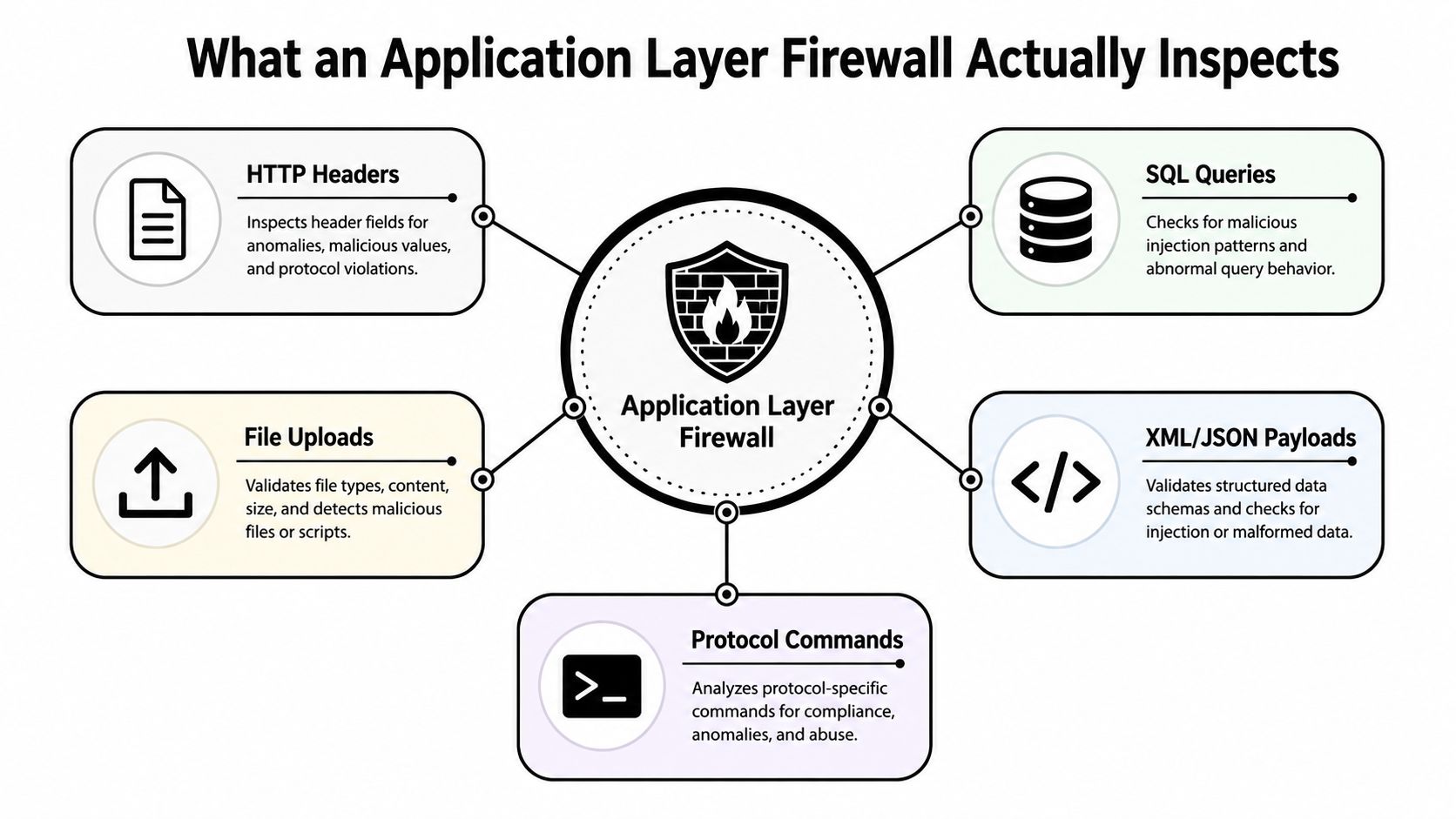
Begin with the request path, not the product label. An application layer firewall works at the highest commonly cited OSI layer, Layer 7, where protocols hold meaning for users and software. Based on its design, it can parse HTTP and HTTPS traffic and may also inspect application protocols including DNS, FTP, and SMTP.
Step one, identify the conversation
The firewall first accepts traffic through a deployment point, frequently a reverse proxy, inline device, or cloud service. It recognizes the protocol, rebuilds the request where needed, and links related messages to a session. Session awareness lets it assess a request in context instead of treating each packet as an isolated object.
With HTTPS, inspection typically depends on the control either terminating the connection or gaining access to decrypted traffic by another means. This introduces a security boundary that requires careful design. Certificates, key management, privacy needs, failure handling, and how the firewall relates to the origin server all shape the deployment.
Step two, normalize and decode
Attackers can express the same value in various encodings. A capable inspection engine normalizes the request before assessing it, decoding relevant content and interpreting protocol syntax so that simple obfuscation does not automatically evade detection.
The firewall may inspect:
- Headers: Host, method, content type, cookies, user-agent values, and additional metadata.
- Queries and parameters: Values provided through URLs, forms, and API requests.
- Request bodies: Data from forms, XML, JSON, and uploaded files.
- Protocol behavior: Improper methods, malformed syntax, irregular sequences, and suspicious command patterns.
- Session context: Connections among requests, authentication state, and application routes.
The mail analogy is helpful in this case. The network firewall observes the delivery address. The application layer firewall examines the fields inside the form and checks whether they align with the expected conversation.
Step three, evaluate rules and decide
Inspection turns into an enforcement control when a rule engine converts parsed content into an action. The OWASP ModSecurity Core Rule Set is a general attack-detection ruleset built for ModSecurity and compatible WAFs. It focuses on common web attacks linked to the OWASP Top Ten while seeking to keep false alerts low.
The outcome could be to allow, block, log, challenge, or route for additional review. The firewall event must capture sufficient context so analysts can tell what matched, which endpoint got the request, and whether the control blocked it or only monitored it.
How It Compares to Packet-Filtering and Stateful Firewalls
Saying more inspection can set the wrong expectation. An application layer firewall is not automatically a superior substitute for every other firewall. Every generation addresses a distinct question, and a solid architecture employs the control suited to the traffic and risk.
Firewall generations at a glance
| Capability | Packet Filter | Stateful Firewall | Application Layer Firewall |
|---|---|---|---|
| Primary view | IP addresses, protocols, and ports | Network attributes plus connection state | Parsed application requests and protocol semantics |
| Session awareness | Limited or absent | Tracks established conversations | Tracks sessions while evaluating request context |
| Payload inspection | Generally unavailable | Limited, depending on features | Examines headers, parameters, bodies, and commands |
| Typical decision | Allow or deny based on network attributes | Allow or deny based on policy and session state | Allow, block, challenge, or log based on application content and behavior |
| Best fit | Basic network access control | Perimeter and segmentation policy | Web, API, and other application-layer protection |
| Main blind spot | Malicious content in permitted traffic | Attacks hidden inside valid sessions | Business logic abuse, unknown flaws, and assets outside coverage |
A packet filter can deny traffic from an unauthorized network or directed to an unapproved port. A stateful firewall contributes useful context by verifying that packets are part of an allowed connection. Neither one necessarily recognizes that a valid HTTP request carries a database instruction or a script payload.
Why Layer 7 changes the question
Below the application layer, SQL injection, cross-site scripting, and certain types of HTTP request smuggling may appear as normal traffic. The destination is valid, the port is open, and the session is properly established. The application layer firewall poses a more profound question: does this request make sense in content and structure for the service that receives it?
That does not mean the control is universal. A network firewall is still the right mechanism for routing boundaries, segmentation, non-application traffic, and broad access policy. Placing a WAF where the service does not expose inspectable application semantics can introduce complexity without improving useful detection.
Teams reviewing perimeter policy can use DesignStack firewall advice as additional configuration context. For traffic requiring detection and prevention past access rules, an intrusion detection and prevention system can work alongside the firewall by inspecting wider network activity and producing security events for correlation.
The practical architecture is layered. Network controls determine who may communicate and where. Application controls examine what the communication requests the service to do. Endpoint, identity, and data controls give visibility into what occurs once a request is accepted.
Deployment Patterns and Where the Bottleneck Lives
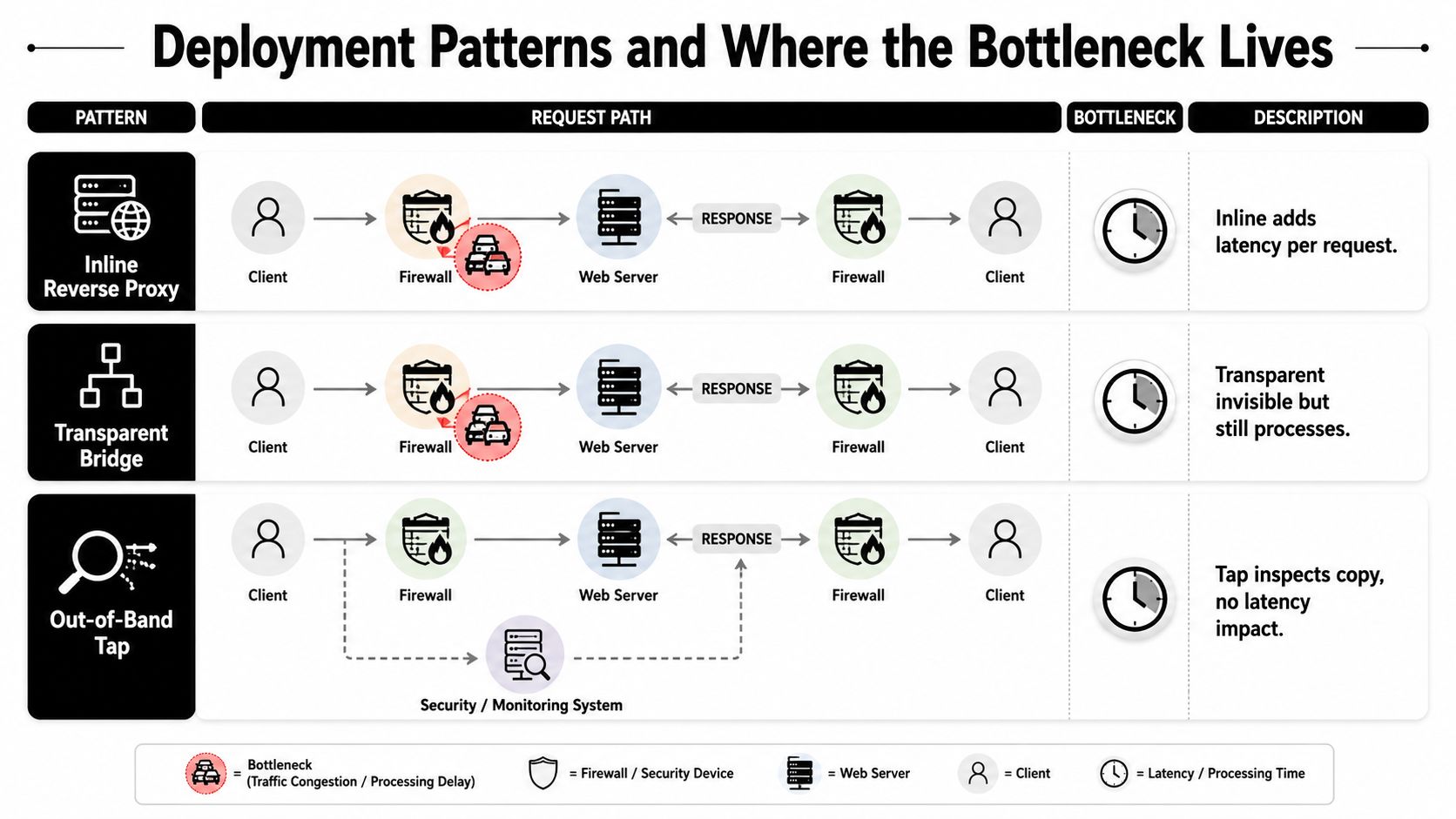
Location affects both visibility and failure behavior. If the control sits in the request path, it can block traffic, yet each parsing operation uses resources and may influence latency. If it is out of band, it can inspect a copy, but it usually cannot enforce a block before the origin gets the request.
Reverse proxy deployment
A reverse-proxy WAF is positioned ahead of the web tier. The client connects to the proxy, which terminates TLS when configured for it, examines the request, and sends approved traffic to the origin.
This approach offers robust control over routing, headers, TLS policy, authentication integration, and application-specific rules. It can also introduce an availability dependency. If the proxy cluster is undersized, misconfigured, or unavailable, legitimate users may face failures even if the origin stays healthy.
Transparent inline deployment
A transparent bridge can examine traffic without making the application treat the device as its public-facing proxy. This can ease some network migrations and support traffic patterns in which proxy changes are hard. It still handles traffic inline, so parsing, buffering, TLS handling, and rule evaluation can place pressure at the inspection point.
A tap or mirrored deployment forwards a traffic copy to an analyzer. That design prevents added inspection latency on the live path, but it shifts the control from prevention to detection unless another enforcement mechanism gets the decision.
Where performance degrades
The peer-reviewed ModSecurity study determined that performance depends on more than rule count. Rule-set complexity and request characteristics also affect throughput, transaction rate, concurrency, and server efficiency under load. Since the firewall is in the request path, deeper HTTP inspection can raise CPU and memory demand before network bandwidth turns into the limiting resource. The ModSecurity performance study supplies the technical foundation for that conclusion.
An independent benchmark puts the tuning effect in concrete terms. A default OWASP-style configuration yielded 120 ms P95 latency and 2,140 requests per second, while a tuned configuration produced 68 ms P95 latency and 2,890 requests per second. The benchmark report credits the difference to the trade-off between inspection depth and per-request processing cost.
Performance checkpoint: Test the rules, decoding paths, request sizes, concurrency, and TLS behavior that you will run in production. A clean network throughput test will not reveal an expensive application inspection path.
Why Default Rules Are Not Enough
A WAF is not a security appliance that you install once and then disregard. Default policies must function across many application designs, so they typically start with broad detection logic and cautious assumptions about false positives. Your application may rely on custom JSON structures, unusual encodings, legacy routes, generated parameters, or business workflows that the generic policy does not grasp.
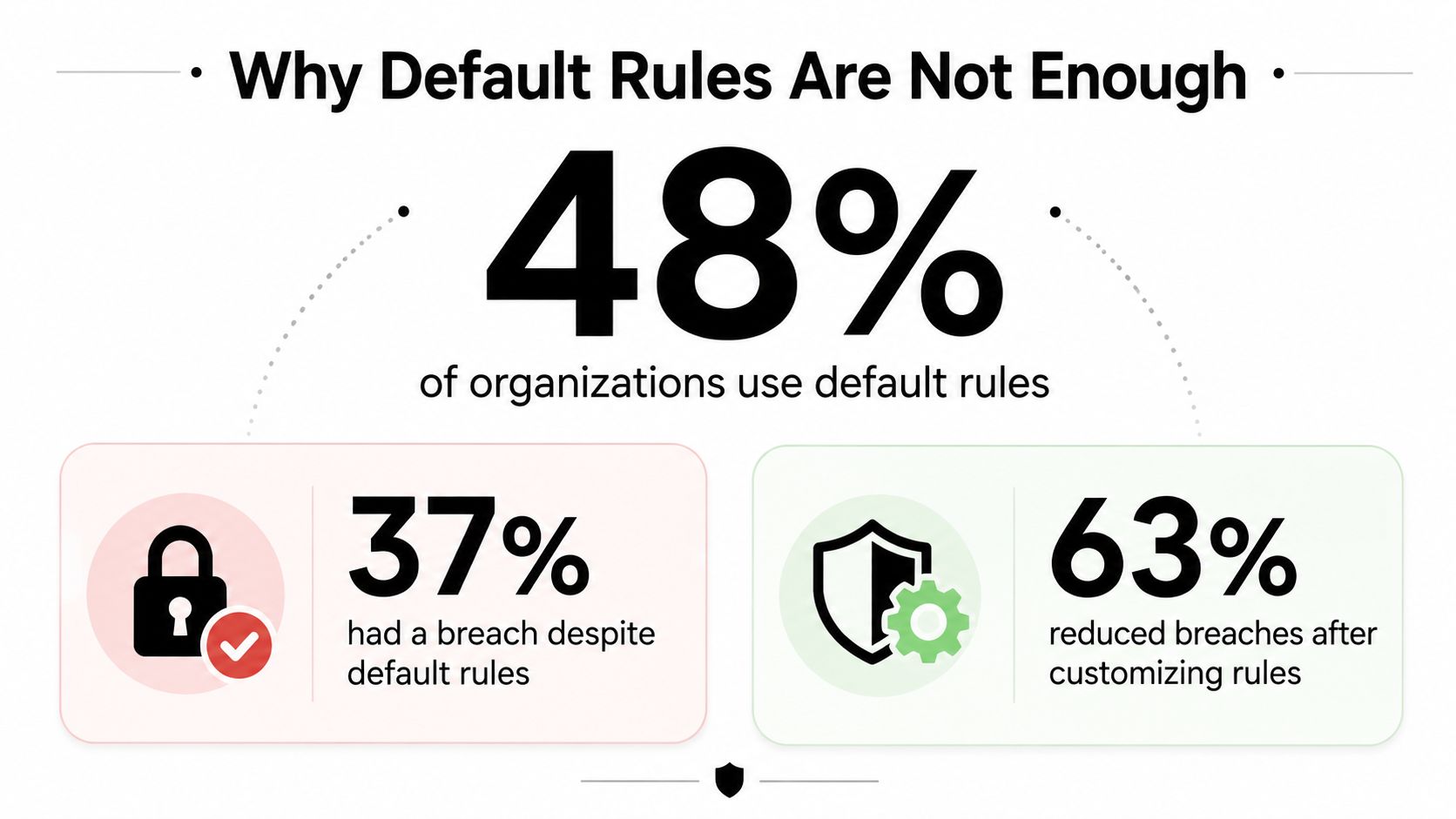
Recent coverage of independent testing found that default WAF rules blocked only 48% of more than 360 tested CVE exploitsThat outcome does not prove a WAF lacks value. It shows that a deployment limited to the initial policy from the vendor may leave a significant detection gap. The coverage of default WAF rule performance backs the practice of treating tuning and validation as part of the security control rather than optional maintenance.
What tuning looks like in practice
A security engineer ought to handle policy changes in the same way as production code. Begin with representative traffic, application documentation, vulnerability findings, and known-good requests. Next, tune detection thresholds, exclusions, route-specific rules, and enforcement modes, keeping evidence for later review.
Useful activities include:
- False-positive triage: Find valid requests that set off rules, then limit an exception by route, parameter, method, or trusted application context.
- Rule-set management: Examine active rules, anomaly scoring, and sensitivity settings rather than blindly turning on every possible inspection path.
- Regression testing: After policy changes, replay known-good traffic and attack simulations so that a fix for one endpoint does not weaken another.
- CVE validation: Check exploitable paths against the precise application version and deployment configuration instead of assuming a matching rule guarantees protection.
- Exception governance: Assign every exception an owner, a reason, a scope, an expiration or review date, and a linked ticket.
The OWASP CRS aims to detect common attacks with minimal false alerts, yet minimum does not equal zero. Application behavior decides whether a generic rule is accurate, noisy, or incomplete.
Coverage comes before sophistication
Even strong policy cannot protect an asset that the team has not inventoried. Independent analysis from 2025 found that 52.3% of cloud-hosted assets lacked WAF protection, compared with 66.4% of non-cloud assets. Among assets that collect personal data, the analysis found no WAF safeguards for 39.3% of cloud assets and 63.4% of off-cloud assets. The enterprise WAF coverage analysis demonstrates why asset discovery and consistent enforcement should come first.
Coverage rule: Before tuning a rule, confirm that every public application, API, and sensitive data path is known, assigned to an owner, and routed through the intended inspection point.
Attack Classes the Firewall Actually Mitigates
The strongest use case for the firewall is content inside a request that matches recognizable attack behavior. It can examine parameters, headers, payloads, paths, and protocol structures, then compare them against rules and contextual thresholds.
Injection and scripting
SQL injection detection searches for suspicious database-oriented syntax in parameters and request bodies. The rule engine can spot combinations of operators, keywords, comments, encoding, and placement that do not match ordinary input. It does not have to understand every database query, but it can recognize patterns tied to an attempt to alter query logic.
Cross-site scripting detection reviews submitted content for script-like markup, event handlers, encoded browser instructions, and other patterns that might run in a browser used by the user. Local file inclusion and path traversal rules check file-related parameters for attempts to access unintended resources.
Command injection detection uses similar logic for operating-system metacharacters and command structures. A request containing shell-like syntax may be blocked or logged if it appears in a parameter that should hold a name, identifier, or search value.
APIs and automated abuse
Modern application layer protection increasingly covers API security, bot management, and Layer 7 DDoS defenses. These capabilities handle traffic that may lack a classic exploit string, such as automated credential stuffing, excessive requests against a costly endpoint, or access to an API route with an unexpected schema.
The boundary is important. A WAF can detect and restrict request patterns, yet it may not know whether a user is allowed to transfer a specific object or whether a workflow breaks business intent. Those situations often call for application authorization controls, identity analytics, and endpoint or database evidence.
The OWASP ModSecurity Core Rule Set is valuable because it converts common application attack knowledge into rules that can be inspected. It enables detection for categories such as SQL injection, cross-site scripting, and local file inclusion, while letting the deployment team tune how those detections affect traffic.
A request that is blocked still constitutes an event; it is not just a packet that was dropped. Retain the source context, target route, matching rule, user or session markers when present, action taken, and response status. With these fields, analysts can tell a random scan apart from a deliberate attempt on a vulnerable endpoint.
Compliance Roles Across PCI, HIPAA, GLBA, and CMMC
An audit may surface a WAF alert, yet the auditor will want to know what occurred before and after it. Compliance frameworks do not regard a WAF alone as evidence of security. They expect identified risk, suitable safeguards, controlled changes, monitoring, and preserved evidence. An application layer firewall advances those goals only if its coverage, policies, logs, reviews, and exceptions are governed.
PCI DSS draws the link most clearly. Requirement 6.6 guidance outlines ways to handle common threats to cardholder data and to inspect input from untrusted environments from top to bottom. A public-facing web application without sufficient code review and application security testing must rely on an automated technical solution to detect and prevent web-based attacks. The PCI application review and WAF guidance presents a WAF as a potential compensating control when secure coding and testing fail to reduce risk enough.
Evidence matters as much as enforcement
For PCI, helpful evidence may include approved WAF policies, change records, rule reviews, exception justifications, test results, alert history, and proof that covered public-facing applications fall within scope. The PCI DSS compliance checklist can assist teams in organizing this material together with wider control requirements.
NIST SP 800-41 Rev. 1, published in September 2009, superseded the original 2002 version and offers a federal benchmark for firewall technology and policy. NIST firewall guidance and policy context backs governance conversations about setting boundaries, documenting rules, and treating firewall controls as policy instead of ad hoc configuration.
HIPAA, GLBA, CMMC, ISO 27001, and SOC 2 address the matter through broader safeguards, risk management, access control, monitoring, change management, and evidence expectations. A WAF can supply technical telemetry and enforcement records, yet it does not substitute for secure development, vulnerability management, identity controls, incident response, or data governance.
The audit question worth asking is precise: which applications are covered by the WAF, what threats does it identify, who examines its decisions, how are exceptions managed, and can the organization show that process?
Feeding WAF Events into SIEM, XDR, and SOAR
A WAF realizes its operational worth when its events become part of the broader security record. One blocked request may be benign scanning. The same source aiming at a vulnerable route, causing authentication failures, and setting off endpoint alerts warrants a different priority.
Build a reliable event path
On-premises WAF appliances often send events via Syslog. Cloud-native services typically offer APIs, event streams, or export integrations. Reverse-proxy deployments might rely on a collector or agent on the proxy host to forward access and security logs.
Normalize fields prior to correlation. At a minimum, keep:
- Source identity: IP address, authenticated user, session marker, host, and user-agent when available.
- Target context: Application, virtual host, route, parameter class, and backend service.
- Detection detail: Rule ID, attack category, severity, matched location, and action.
- Outcome: HTTP response status, request disposition, and whether the origin handled the request.
- Timing: Event timestamp and request duration, aligned with the remaining SOC telemetry.
Enrichment may contribute asset ownership, vulnerability findings, threat intelligence, identity risk, and endpoint context. A WAF alert gains value when the SIEM knows the targeted endpoint supports a payment application and the destination server has a related unpatched weakness.
Correlate behavior, not isolated blocks
A practical correlation rule can bring together a burst of WAF blocks from one source, a known vulnerable endpoint, and authentication failures against the same application. The rule should increase confidence when events share a time window, target, session, or attack category, while avoiding a rigid threshold that turns every busy public service into an incident.
A SOAR playbook can then carry out a graduated response. It might enrich the source, notify the application owner, apply a temporary firewall action, isolate a related endpoint when endpoint evidence indicates compromise, and open a ticket with the matched requests and vulnerability context. Human approval can still be required for disruptive actions, particularly when shared infrastructure or partners could be affected.
Threat detection and response solutions offer helpful context for linking WAF telemetry to broader detection and response processes. Unified Security Stack can collect security data from network devices, cloud services, and endpoints via APIs, Syslog, NetFlow, and agents, then correlate events, support automated response playbooks, and map evidence to compliance workflows.
The architect's aim is not to maximize blocked requests. It is to establish a defensible chain from request inspection through detection, investigation, response, and improvement. Examine blocked and allowed samples, measure false positives, test coverage following application changes, and return lessons to both WAF policy and application remediation.
Unified Security Stack consolidates WAF, network, endpoint, vulnerability, and compliance telemetry within an open-source SIEM, SOAR, and XDR workflow, with correlation rules and automated playbooks for coordinated response. Visit Unified Security Stack to assess how its event ingestion and compliance capabilities can link application-layer protection with the rest of your SOC.