Leading cybersecurity risks and ways to guard against them.
Data breaches appear daily in cybersecurity headlines, and if you lack adequate security controls, your business might be next! Employees frequently cause breaches when they ignore procedures or fail to educate themselves on best cybersecurity practices. Preventing internal risks within companies helps organizations stop leading cybersecurity threats from outside factors. Cybercriminals seek vulnerabilities to act as threat actors and breach corporate networks because of employee ignorance.
Organizations need to put a plan in place to stop cyber threats and guarantee digital security. In this article, you will discover all the information required to help organizations prevent cyber threats. The cybersecurity plan will also assist enterprises in recognizing when genuine and fake hacking occurs so they can avoid extortion.
Top cyber security threats between 2020 and 2021
Phishing scams
On the authority of the FBI, phishing scams ranked as the most prevalent cyber-attack type in 2020. They rose from 114,702 incidents in 2019 to 241,342 in 2020, with adjusted losses exceeding $54 million. Phishing scams occur when you get a message that appears to come from a trustworthy source in an attempt to obtain your personal information. It may arrive as an email, a text message, or via social media. Steer clear of messages from unknown people requesting your username and password or credit card details.
Never respond to these messages or open any links they contain.
Ransomware attacks
As stated by the FBI, ransomware incidents keep increasing, with 2,474 cases reported in 2020. Based on the Coveware report, data exfiltration extortion often takes place between Q4 2020 and Q1 2021. The average ransom payment rose 43% from $154,108 in Q4 2020 to $220,298 in Q1 2021. The 70% of ransomware attacks that involved a threat to release stolen data in Q4 grew 10% in Q1. The leading attack vectors included remote desktop protocol compromise, phishing emails, software vulnerability, and vulnerabilities in VPN appliances.
Yet a recent Coveware report indicates that the median ransomware payment fell 40% in Q2 2021. Ransomware attacks are cyber-attacks that prevent users from accessing their system by encrypting files and records on the device. They are usually executed through email attachments, fake software updates, or malware downloads. The attacker then asks for payment in exchange for restoring access to the hacked device. It may also be spread through an infected USB drive.
Business Email Compromise (BEC)
As reported by the FBI, BEC schemes remained the most costly in 2020: 19,369 complaints with an adjusted loss of about $1.8 billion. BEC is a social engineering and fraud method in which hackers spoof or compromise employees' emails through keyloggers or phishing attacks to carry out fraudulent transfers. Typically, the emails belong to someone with access to the company's wire transfer information. Many of these attacks succeed because they mimic many of the same steps as genuine business emails.
DDoS attacks.
As believed by the article made by SOC and SIRT team from F5, DDoS attacks grew by 55% from January 2020 to March 2021. They are also growing more complex, with 54% of incidents employing multiple attack vectors. During the past 15 months, the largest attack measured 500 Gbps and used at least five different attack vectors. A DDoS can target a specific website or internet service. It can also impact an entire network by targeting infrastructure such as DNS servers or routers that help connect to the internet.
Hackers can execute it by leveraging many compromised devices at once to send traffic to the target website. The cybercriminal sends floods of requests from every device so the server cannot answer them. It can also employ a botnet made up of infected devices, all managed from one central point. This attack leads to connection failure and makes it hard for users to reach sites on the internet.
Guide to preventing cyber security threats in your company
Hires qualified IT security staff
Technology evolves, cybercriminals' techniques evolve, and the approach to protecting companies must evolve too. Basic antivirus and firewalls became a thing of the past, giving rise to new methods of cybersecurity management. As a result, organizations need to hire Information Technology engineers or technicians who can manage advanced cybersecurity tools. These experts must also understand the network monitoring process to detect any suspicious activity in real-time. Large companies typically have their own IT team responsible for handling all cybersecurity concerns and advanced tools like SIEMs.
However, small and medium-sized businesses (SMBs) do not share the same fate and become attack targets. Today, a sound solution is to hire cyber-security services that offer the complete package (security, highly qualified personnel, and profitability).
Implements advanced technologies
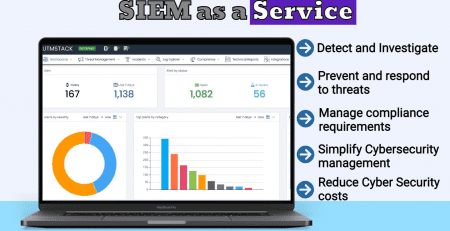
Organizations should make sure they use the most advanced software and hardware to lower the risk of outside threats. In today's age, the best tools for preventing cyber threats are SIEMs that include cyber threats intelligence technology, vulnerability assessment, incident response, Unified Threat Management, among others. SIEM tools meet numerous compliance requirements that enrich an incident response plan, helping with the detection and eradication of threats. Generally, SIEMs are costly for small and medium-sized businesses. However, Unified Security Stack were purpose-built to protect them affordably.
Configures cybersecurity policies and protocols
Cybersecurity protocols guarantee the security and integrity of data as it moves across the network. Organizations must set them up to stop unauthorized external individuals from accessing, manipulating, or destroying the information. They must also use them to limit employee access to business networks, data servers, and cloud storage systems. If you manage the network protocols (TCP / IP) and authentication protocols, along with the company's security policies, you will help minimize the risk of threats.
Additionally, it is advisable to encrypt sensitive files, keep a backup ready for all essential data, use a VPN, use strong passwords and change them regularly. However, if your organization cannot have a SIEM tool, installing antivirus and antimalware software is always an option.
Naturally, don't forget to keep each application and piece of software you use up to date.
Trains employees
Today's cyber threats are more advanced and intricate than at any previous point. Staff require ongoing training to recognize when they are targeted by Phishing, Ransomware, DDoS, or other cyber-attacks. Companies must build a robust cybersecurity culture that begins with the CEO and extends throughout the organization. No-cost cybersecurity training is essential so employees do not unknowingly spread malicious software. It also helps the security team stay current on emerging attacks, hacking methods, and processes for detecting and eliminating them.
Follow up
IT managers must regularly put controls in place to verify that employees comply with computer security policies. The role differs according to company size; even so, that control should never be absent. When you observe employee conduct, access, and network settings, the organization becomes less vulnerable to external or internal cyber threats.