Endpoint Protection Platform: A CISO’s Guide for 2026
Endpoints are the primary targets and entry points for 72% of all cyber attacksThat one reality should reshape how a CISO views the endpoint protection platform. It is not merely an antivirus upgrade or an IT hygiene line item. It is the control positioned at the business edge under heaviest attack.
For most organizations, endpoint no longer refers solely to employee laptops. It also covers Windows and Linux servers, managed and unmanaged mobile devices, virtual desktops, engineering workstations, point-of-sale systems, and the broad set of operational devices still connected to core business processes. If such systems are where users operate, data flows, credentials reside, and malware arrives, they should be part of the endpoint security discussion.
A current endpoint protection platform is important for two often overlooked reasons. First, it now features in cyber insurance underwriting discussions. Second, its telemetry delivers much greater value when it flows into a SIEM, XDR, or SOAR workflow rather than remaining in a separate console. That is where the platform moves from a standalone prevention tool to a central element of security architecture.
Table of Contents
- Why Endpoint Security Is Your First Line of Defense
- Deconstructing the Endpoint Protection Platform
- EPP vs EDR vs XDR A Clarity Guide
- Inside a Modern EPP Core Components and Detection
- Integrating EPP with Your SIEM XDR and SOAR
- The Business Case EPP for Compliance and Insurability
- EPP Selection Checklist for CISOs and MSSPs
Why Endpoint Security Is Your First Line of Defense
Attackers seeking an initial foothold typically target the places where users and workloads already run. Email attachments arrive on endpoints. Browser sessions end on endpoints. Stolen credentials are used from endpoints. This practical reality explains why the endpoint protection platform appears so early in the kill chain.
An endpoint may be a laptop, server, mobile device, kiosk, or any managed device supporting business activity. In hybrid environments, many of these systems remain outside the traditional corporate perimeter for extended periods. Security teams cannot assume network controls will always observe the first malicious action.
What the first line of defense actually means
An endpoint protection platform serves as the preventive layer on the device itself. Its role is to block common and advanced threats before they execute, spread, or gain persistence. If that sounds elementary, it is not. Effective endpoint prevention cuts noise upstream and prevents the SOC from devoting time to avoidable infections.
This is significant in layered security. Host-based prevention does not substitute for network monitoring, identity controls, or a logging strategy. It leaves those layers with fewer incidents to handle. Teams seeking a clear understanding of how layered controls strengthen one another should understand CEF data protection within the wider context of defense-in-depth.
Practical rule: When a control must wait for traffic to reach a central appliance before taking action, expect it to overlook some of your endpoint risk.
Where teams get this wrong
A frequent failure mode is treating endpoint security as a commodity checkbox. Deploy an agent, apply a default policy, and assume covered equals protected. That approach fails quickly in real environments. Exceptions accumulate. Developer endpoints require different controls than finance workstations. Servers need stricter change management than roaming laptops. Executive devices often need tighter isolation, not looser handling.
A CISO should expect the endpoint program to answer basic questions fast:
- What assets are actually protected: Inventory drift occurs often, particularly following mergers, contractor onboarding, and expansion of remote work.
- Which policy applies to which class of device: A single uniform policy typically produces either operational friction or security gaps.
- How quickly can the team contain a bad endpoint: Prevention delivers the greatest value when it shortens the route to containment.
The endpoint protection platform justifies its role by enforcing policy on the host, not by reporting only after an event.
Deconstructing the Endpoint Protection Platform
The name itself is where most confusion begins. An endpoint protection platform, or EPP, may sound broad enough to encompass everything on the endpoint. It does not. Its center of gravity remains prevention.
Picture EPP as the security guard stationed at the building entrance. The guard inspects what enters, stops clear threats, enforces building rules, and restricts what visitors may do once inside. That guard is not conducting the full investigation after a break-in. That is a separate function. Yet if the guard is weak, the rest of the building spends its time dealing with preventable incidents.
What an EPP is responsible for
In practical terms, an EPP runs on the endpoint and applies controls directly on that system. The platform usually performs several tasks at the same time:
- Malware prevention: Blocks known malicious files and suspicious payloads before execution.
- Exploit blocking: Disrupts execution patterns linked to common attack techniques.
- Policy enforcement: Limits unapproved software behavior, removable media use, or risky local actions.
- Host-level control: Delivers safeguards even when the endpoint is not connected to the network.
These functions matter because endpoint prevention acts faster than waiting for an external system to detect that something harmful has already occurred. If the process never begins, the incident never grows into a broader response problem.
What an EPP is not
An EPP differs from legacy antivirus, even though antivirus features are frequently included. Legacy AV concentrated largely on matching files to known signatures. A modern EPP still relies on signatures when they are useful, but it introduces additional methods for evaluating host activity and policy violations.
It also is not a complete investigation platform on its own. Through EPP, a security team can obtain alerts, quarantine files, and enforce policy. Yet if an attacker bypasses prevention and begins moving through identity, cloud, email, and network layers, the standalone EPP console will not provide enough context to reconstruct the full incident.
The most effective endpoint programs do not expect EPP to handle everything. They expect it to perform prevention well, then link it to the rest of the detection and response stack.
Why the distinction matters in procurement
Vendors frequently blur category lines because buyers prefer single-platform stories. That is understandable, yet it can mislead. During evaluation, keep these questions separate:
| Evaluation point | What to ask |
|---|---|
| Preventive strength | Can it stop malware, exploits, and dangerous activity on the host? |
| Operational usability | Can administrators manage policy consistently across different categories of devices? |
| Telemetry value | Can security teams export relevant events into broader workflows? |
| Response scope | Is its coverage confined to the endpoint, or does it enable wider investigation elsewhere? |
If the team cannot answer those four questions clearly, the product category likely is not being described clearly either.
EPP vs EDR vs XDR A Clarity Guide
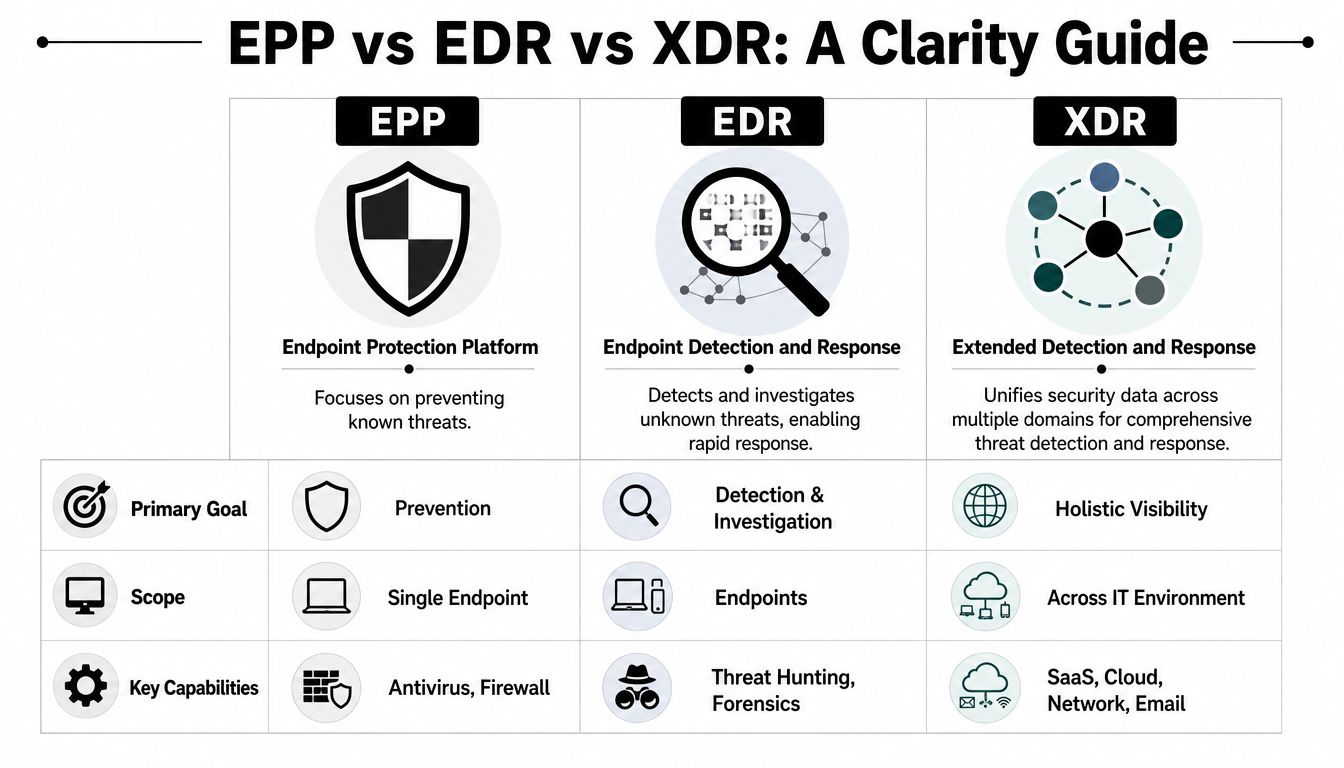
Security buyers continue to encounter category confusion because labels overlap and vendors merge them into a single narrative. The simplest way to consider it is this. EPP handles prevention. EDR handles investigation and response on the endpoint. XDR handles correlation across domains. Traditional antivirus has a narrower scope than all three.
Begin by looking at the visual comparison.
The functional difference that matters
The main error is treating EPP and EDR as substitutes. In a mature program, they are not. A practical architecture uses the endpoint protection platform to block what it can at execution time, then uses EDR to investigate what still gets through or appears suspicious after execution starts.
The most effective approach for modern hybrid environments is a unified platform where NGAV, intrusion prevention, and data loss prevention work in tandem with EDR telemetry to stop both known and unknown threats, as outlined in ManageEngine's explanation of endpoint protection platforms.
A side-by-side table makes that concept easier to see.
| Technology | Primary Focus | Key Capability | Analogy |
|---|---|---|---|
| Antivirus | Known malware blocking | Signature-based scanning | A guard checking a printed list of banned visitors |
| EPP | Prevention on the host | Blocks malware, exploits, and policy violations | A building guard enforcing entry rules and basic safety controls |
| EDR | Detection and response on endpoints | Investigates suspicious activity and supports containment | A detective reconstructing what happened inside the building |
| XDR | Cross-domain correlation | Connects endpoint, cloud, identity, network, and email signals | A command center seeing the entire incident across the city |
The video below provides helpful high-level context before a team delves deeper into architecture decisions.
How to use each in a real program
This is not merely a naming concern. It influences budgeting, staffing, and escalation paths.
- Use antivirus for baseline hygiene: It still serves a purpose, but by itself it is not a modern endpoint strategy.
- Use EPP for front-line prevention: This lowers preventable infections and reduces attack surface on the device.
- Use EDR for host investigation: When prevention fails, analysts require endpoint timelines, process visibility, and containment capabilities.
- Use XDR when incidents cross boundaries: Misused credentials, cloud access, and lateral movement frequently need broader correlation than endpoint data alone can offer.
Where procurement teams get misled
Certain products promote all-in-one endpoint security, yet their underlying capabilities still vary. Ask the vendor to demonstrate exactly which controls operate before execution, which telemetry remains available after execution, and which external data sources the product can correlate natively or through integration.
When every response boils down to saying AI takes care of it, dig deeper. Architecture remains important. Scope does too.
Inside a Modern EPP Core Components and Detection
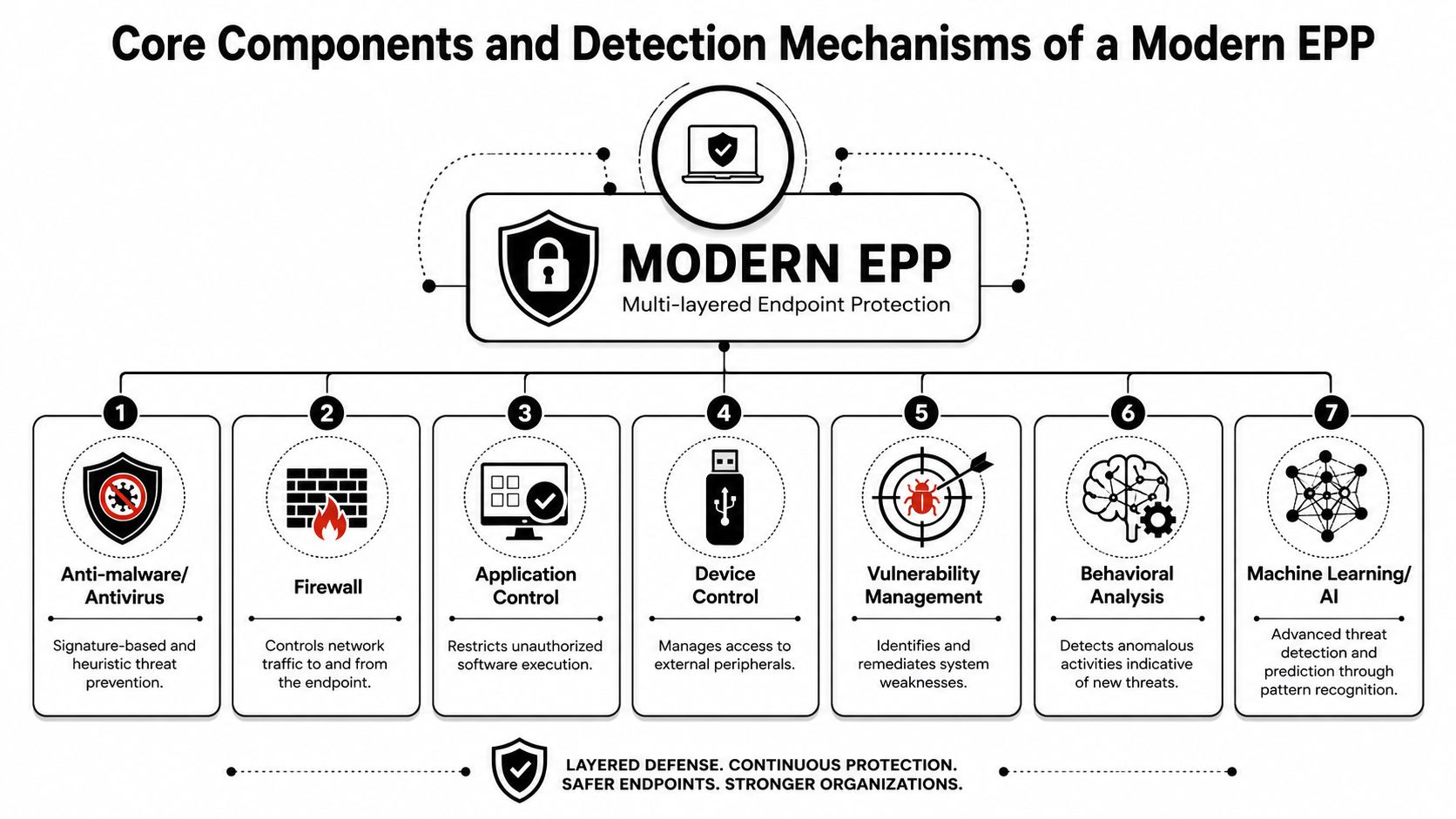
Today's endpoint protection platform depends on more than a single detection technique. Its strength comes from multiple controls working side by side on the endpoint, with each control addressing a distinct gap. Signature matching remains important, yet on its own it cannot withstand fileless attacks, living-off-the-land activity, or never-before-seen payloads.
To assess an EPP properly, examine its detection stack rather than only the category it markets itself under.
Why signatures alone aren't enough
Signature-based detection addresses one limited question: have we encountered this precise malicious pattern before? This helps with known malware families and commodity threats. It falls short when an attacker alters the file, stays off disk, misuses trusted tools, or runs code in memory.
That's why modern endpoint protection platforms achieve near-100% malware defense through a multi-engine architecture combining signature-based detection with Next-Generation Antivirus powered by artificial intelligence and behavioral analysis, which detects fileless malware and zero-day exploits by monitoring memory anomalies and policy violations, according to the benchmark summary from SecurityBrief.
What sits inside the detection stack
A strong EPP usually combines several layers:
- Signature and heuristic inspection: Rapid filtering for recognized malicious files and familiar threat characteristics.
- Behavioral analysis: Monitors processes, parent-child links, script execution, memory activity, and suspicious system operations.
- Policy-based controls: Prevents execution paths or actions that breach established device policies.
- Application and device control: Limits the use of unapproved binaries, scripts, and peripherals.
- Host firewall and exploit protection: Lowers exposure to abuse on local networks and exploit chains.
One control alone is insufficient. Combined, they turn the endpoint into a tougher target and lower the chance that a single evasion method succeeds.
Why behavioral monitoring changes the game
Behavioral analysis separates knowing a file from knowing an action is dangerous. This matters because many endpoint intrusions do not initially resemble classic malware. They appear as PowerShell, script interpreters, office macros, or admin utilities acting in ways they should not.
Operational advice: Adjust prevention to focus on behaviors attackers require, not merely on malware families you have already identified.
This method also reinforces detection engineering. Groups that build analytics focused on endpoint behavior, process chains, and policy exceptions gain more from the platform than groups that monitor only malware verdicts. When your SOC is actively honing host-based logic, a disciplined detection engineering program provides much greater operational value for that telemetry.
Trade-offs security teams should expect
The trade-offs are genuine. Stronger prevention may disrupt legitimate admin tasks, software deployment, and custom tooling. A lighter policy lowers friction, yet creates space for abuse. No universal ideal setting exists.
That's why mature teams phase controls:
| Control area | Conservative rollout | Mature rollout |
|---|---|---|
| Application control | Audit mode on broad groups | Enforce on high-risk populations and critical assets |
| Script restrictions | Limited blocking with exceptions | Tight policy based on role and signed tooling |
| Device control | Monitor removable media | Restrict by business need and data sensitivity |
The correct EPP is not simply the one with powerful engines. It is the one your team can adjust, enforce, and tolerate.
Integrating EPP with Your SIEM XDR and SOAR
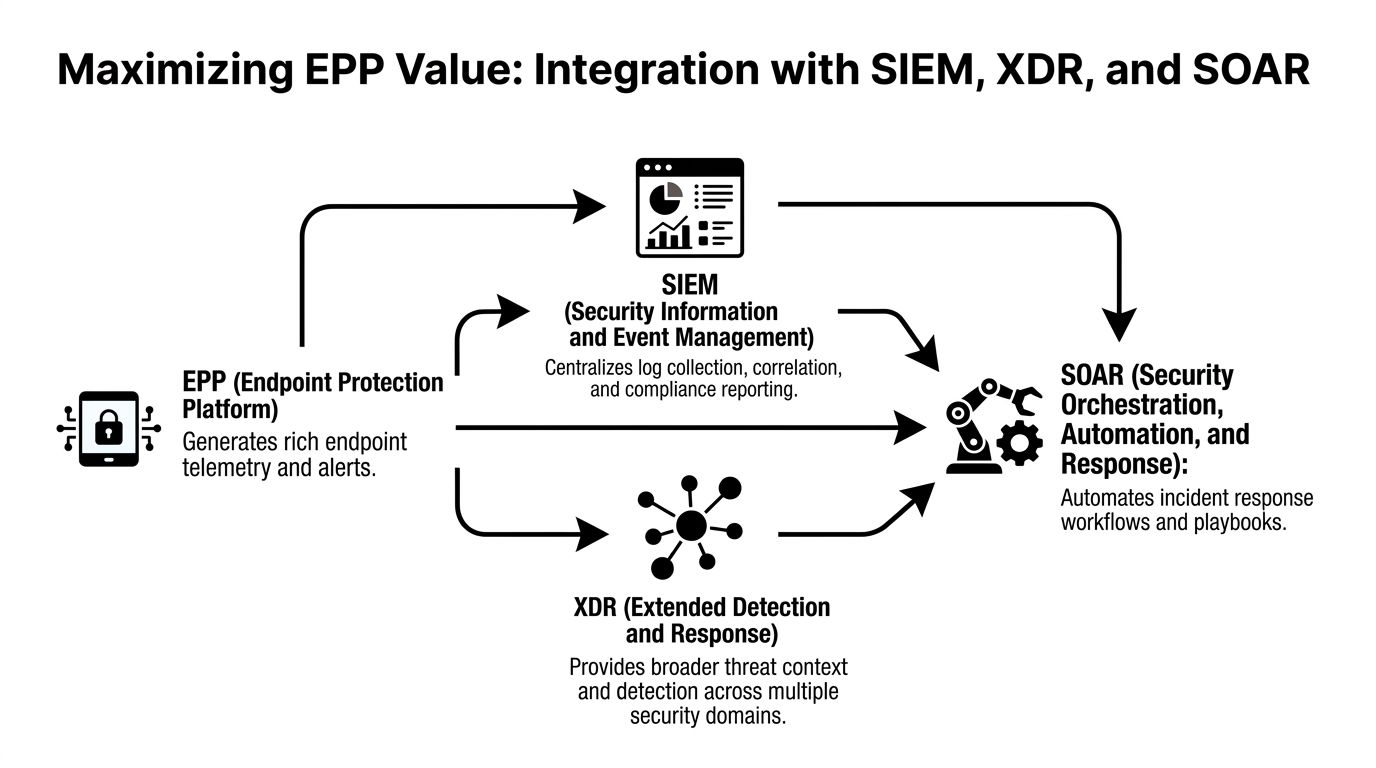
An isolated EPP can block malware and generate valuable host alerts. That has worth, but it is constrained. Most serious incidents do not remain within a single endpoint or console. They involve identity, cloud workloads, email, DNS, network traffic, and privileged access. When the endpoint protection platform does not feed broader security operations, you force analysts to reconstruct incidents by hand.
That is the point where many programs encounter the integration blind spot.
Why isolated EPP creates response drag
The endpoint console can generally inform you that a malicious process started, a file was quarantined, or a host was isolated. It often cannot tell you whether that same user just signed in from an unusual location, whether a cloud token was misused minutes later, or whether another host reached the same destination.
That missing context is not a minor operational concern. Organizations using isolated EPPs experience 3x longer mean-time-to-respond because they lack the contextual correlation found in unified XDR or SIEM platforms that ingest EPP logs via Syslog or API.
What good integration looks like
At a minimum, a modern endpoint protection platform needs to send telemetry and alerts to a central analysis layer. In practice, this typically involves API collection, Syslog forwarding, vendor connectors, or agent-based ingestion into a SIEM or XDR platform.
Once the data lands centrally, security teams can correlate endpoint events with:
- Identity signals: Suspicious sign-ins, privilege escalation, impossible travel, MFA irregularities.
- Cloud and SaaS logs: Admin activity, token usage, mailbox modifications, storage access.
- Network evidence: Lateral movement, outbound anomalies, protocol abuse, beaconing patterns.
- Automation layers: SOAR playbooks that isolate a host, disable a user, create a case, or enrich the alert.
One platform that fits this model is Unified Security Stack threat detection and response, which takes in endpoint and other security telemetry to support correlation, automated response, and compliance workflows. Whatever product you choose, that architectural pattern is what counts.
Endpoint telemetry becomes far more useful when the SOC can ask, "What else happened around this alert?" instead of "Which console do I open next?"
How to operationalize the connection
Integration being impossible is rarely the reason teams fail. They fail when they settle for basic forwarding and never put the data to work. To steer clear of that, start by building around a small number of use cases.
Host compromise plus identity risk
Tie malicious process activity to high-risk authentication behavior coming from the same user.Repeated low-severity alerts across hosts
One blocked script might be nothing more than noise. When that same pattern appears across numerous endpoints, it can point to campaign activity.Automated containment with analyst approval
Let SOAR prepare actions automatically, then have an analyst approve host isolation or account disablement.
A SIEM or XDR is not a substitute for endpoint controls. Its role is to make endpoint telemetry understandable within the context of the full incident.
The Business Case EPP for Compliance and Insurability
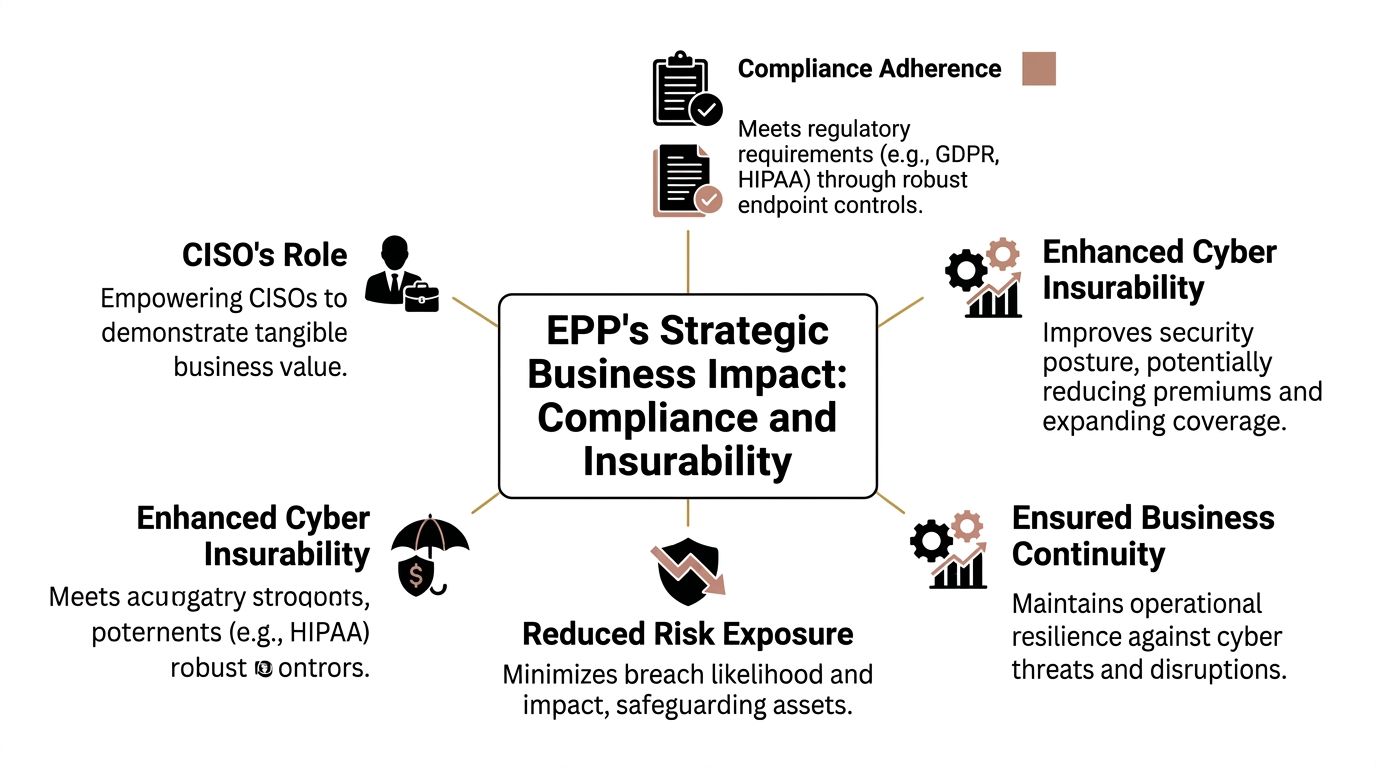
Endpoint spending is frequently defended by security leaders in technical language. Improved malware prevention. Greater visibility. More response choices. Those reasons hold up, yet they carry little weight in the boardroom or in underwriting discussions. The more compelling business argument is that a properly configured endpoint protection platform helps produce compliance evidence, closes control gaps that could have been avoided, and may determine whether the organization stays insurable.
That shift carries weight because insurers and auditors are unconvinced by the claim of simply owning a tool. Their concern is whether controls are deployed, enforced, and backed by evidence.
Why underwriters care about endpoint controls
Cyber insurance questionnaires are now far more detailed. Asking whether endpoint protection exists is no longer enough. They ask whether hardening and response capabilities are in place, whether patching is current, whether backups are protected, and whether enforcement stays consistent across the entire fleet.
The pressure is clearly defined. 90% of cyber insurers explicitly mandate EDR capabilities and endpoint hardening as non-negotiable requirements for insurabilityThis is not simply a question of marketing choice. It serves as a mandatory underwriting checkpoint.
An underdeveloped endpoint program creates two business issues. It increases the likelihood of an actual compromise, and it weakens the organization's capacity to demonstrate reasonable control maturity when coverage is assessed or renewed.
Mapping EPP to compliance reality
An endpoint protection platform further supports several control families common to regulated industries. No product on its own makes an organization compliant, yet it assists in implementing and evidencing the requirements auditors regularly examine.
| Framework area | Where EPP contributes |
|---|---|
| HIPAA | Malware prevention, device control, centralized policy enforcement on covered systems |
| PCI DSS | Host protections on in-scope endpoints and tighter control over software behavior |
| CMMC | Endpoint hardening, anti-malware enforcement, and support for monitored response workflows |
| ISO 27001 | Technical enforcement, endpoint monitoring, and auditable control implementation |
| GLBA and SOC 2 | Host-level safeguards, policy consistency, and evidence of operational control |
When the wider security stack covers change evidence and file monitoring, the audit trail becomes even stronger. For instance, file integrity monitoring can supplement endpoint policy and host protection evidence in regulated environments.
What CISOs should present to finance and audit teams
A business-facing explanation should stay concrete:
- Coverage posture: Which classes of endpoints are protected, and how policy varies by risk tier.
- Control enforcement: Whether malware prevention, device restrictions, and hardening baselines are enabled and running.
- Evidence quality: Whether the team is able to produce policy status, exceptions, alerts, and response records.
- Insurance alignment: Whether endpoint controls align directly with underwriting questions.
A security control turns into a business control once you can demonstrate that it exists, that it is enforced, and that exceptions are governed.
At that point, endpoint security no longer sounds like a tactical purchase; it reads like governance.
EPP Selection Checklist for CISOs and MSSPs
Purchasing an endpoint protection platform is seldom only a product decision. It is an operating model decision. The wrong choice produces alert noise, broken deployment cycles, analyst frustration, and exception sprawl. The right choice matches your device mix, your SOC workflow, and your regulatory environment.
The checklist below is the one I use to tell genuine endpoint platforms apart from polished demos.
Detection and prevention efficacy
Begin here, rather than with licensing.
- Demand third-party validation: Give priority to independent efficacy testing and peer review rather than vendor claims. If the evaluation begins with branded slideware instead of externally validated results, pause and restart the process.
- Verify modern prevention methods: The platform needs to merge signature detection with NGAV-style behavioral analysis. If the product still acts like legacy antivirus with a newer console, it will not keep up with current attack methods.
- Test fileless and script-based abuse: Ask how it deals with in-memory behavior, suspicious scripts, policy violations, and misuse of legitimate admin tools.
- Inspect containment actions: Quarantine has its place. Host isolation, process termination, and policy-based blocking are more important when a device is under active abuse.
A pilot should encompass real administrative tools, software deployment processes, and developer workflows. Lab-only validation conceals operational friction.
Management and operational fit
A capable engine is of no use if your team cannot run it cleanly.
Policy design and exception handling
Examine closely how the product manages policy scope. You need separate policies for servers, standard users, privileged users, developers, and business-critical assets. If exceptions are managed through ad hoc local overrides, the platform will drift quickly.
Check for these operational basics:
- Role-aware policying: Different device classes should enable different control profiles without custom chaos.
- Change discipline: Security teams need the ability to stage, audit, and safely roll back policy changes.
- Exception governance: The platform should record who approved the exception, for what reason, and for how long.
Performance and user impact
The endpoint agent has to stay light enough that IT does not meet immediate resistance from users and platform teams. Agents that demand heavy resources are disabled, bypassed, or pushed aside politically.
You should ask:
| Operational question | Why it matters |
|---|---|
| Does the agent use minimal CPU and memory resources? | Endpoint security that degrades user systems won't survive long-term |
| Can the console administer all major OS types from a single location? | Fragmented management creates blind spots and inconsistent policy |
| Can policies be observed in real time? | Security teams need fast confidence during incidents and audits |
Platform and integration requirements
An endpoint platform that cannot integrate cleanly becomes a silo. That hurts enterprise teams and MSSPs alike.
Logging, API, and SIEM readiness
Verify how the product exports telemetry. Strong answers include API access, documented connectors, and structured event forwarding. Weak answers depend on CSV exports, manual pulls, or vague roadmap promises.
Look for:
- Usable telemetry: Process, alert, policy, and host state data should be exportable in a format the SIEM can consume.
- Correlation readiness: Events should carry enough context to link back to user, host, action, and outcome.
- SOAR compatibility: The product should enable automated containment or orchestration hooks without brittle custom scripting.
Coverage across your actual estate
Numerous endpoint programs break down at the edges. This is not due to a poor product, but because the buying team scoped only the mainstream fleet.
Check support for:
- Servers and workstations: Particularly in estates that combine Windows and Linux.
- Roaming devices: Laptops that remain off VPN or outside managed network boundaries for long periods.
- Privileged and sensitive endpoints: Regulated workloads, administrative workstations, financial devices, and executive systems.
- MSSP multi-tenancy needs: For an MSSP, delegated administration and tenant isolation are not optional.
Start your purchase with the difficult areas of your environment. A simple desktop fleet won't reveal whether the platform can withstand pressure.
Vendor quality and commercial reality
Even a technically capable product may fail when the vendor's approach does not suit your organization.
Support and deployment maturity
Inquire how large-scale deployment functions, how upgrades are managed, and how support reacts during an active incident. Poor support quality means your team pays through wasted time and slower containment.
Evaluate:
- Implementation quality: Does the vendor offer straightforward deployment instructions and baseline policies?
- Support depth: Can you contact a person who knows endpoint operations rather than only licensing?
- Documentation quality: Strong documentation speeds deployment and cuts down on brittle custom setups.
Licensing and total cost of ownership
Do not make procurement solely about per-endpoint cost. Total cost of ownership covers administrative load, integration work, agent clashes, exception handling, and the personnel required to operate the platform.
An inexpensive EPP may turn into the costly choice when it delivers limited telemetry, weak policy enforcement, or ongoing tuning demands.
Final decision criteria that actually matter
If I had to reduce selection to a short board-level summary, it would be this:
- Can it deliver effective prevention on the host?
- Is your team able to run it without sparking policy chaos?
- Can it deliver valuable telemetry to your SIEM, XDR, and SOAR processes?
- Can you demonstrate its worth to auditors, insurers, and senior executives?
When any of those answers remains unclear, continue your assessment. Endpoint security is not a category to purchase based only on brand.
If you're evaluating how endpoint telemetry should feed a broader security and compliance program, Unified Security Stack is one option worth reviewing. It brings together SIEM, SOAR, and XDR capabilities, allowing teams to take in endpoint events together with cloud, network, and identity data, correlate incidents, automate response, and support reporting for frameworks including HIPAA, GLBA, CMMC, PCI, ISO 27001, and SOC 2.